
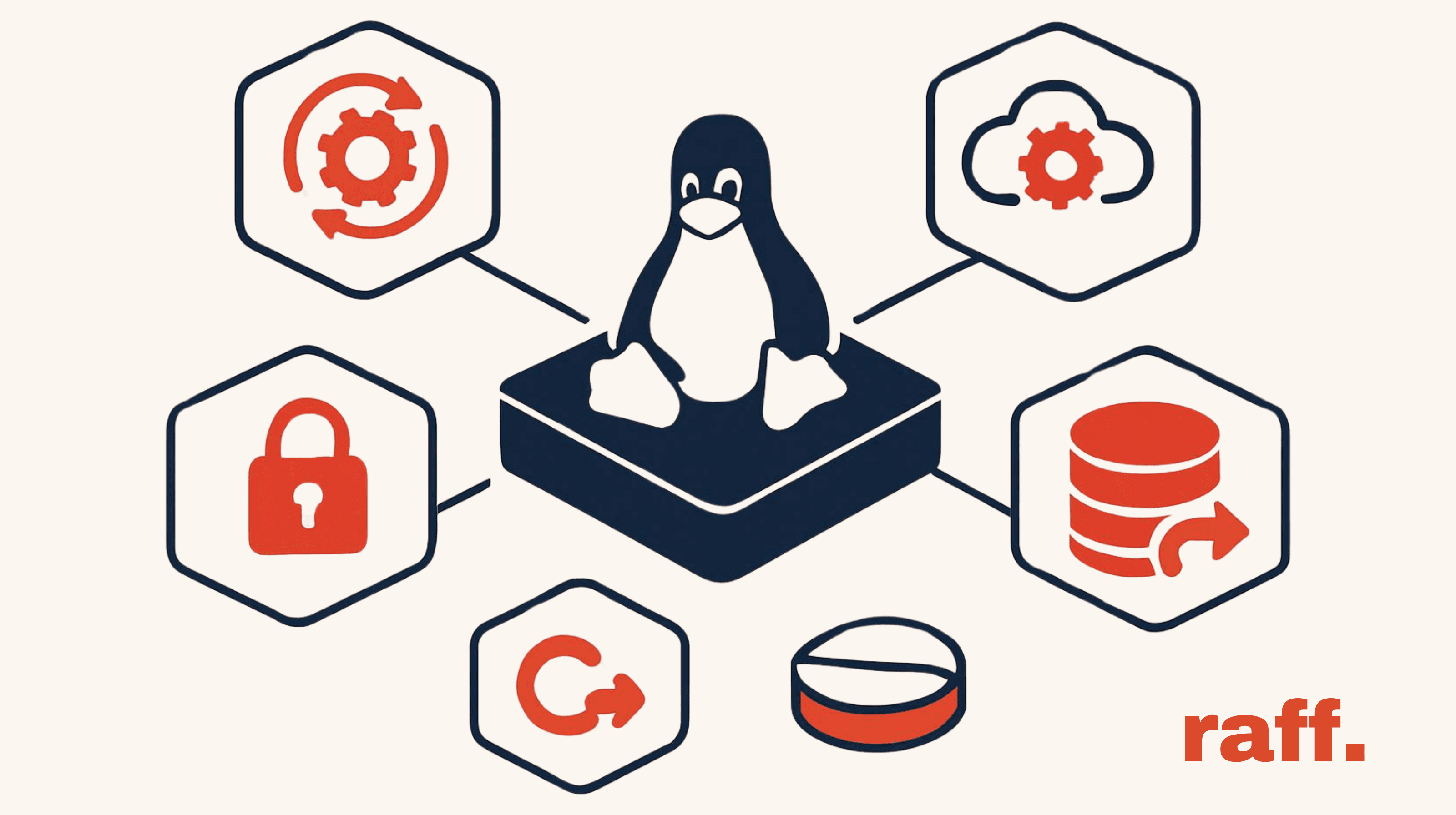
A good Linux VM base image is not just a bootable operating system. It is a starting state you can trust under automation, at scale, and under pressure. At Raff Technologies, that means we do not judge an image by whether it launches once. We judge it by whether package state is current, boot behavior is predictable, SSH defaults are sane, cloud-init is boring, disk expansion works cleanly, and rollback is possible when something changes underneath it.
That sounds strict, but base images deserve that level of suspicion. Every small mistake in a base image gets multiplied. One weak SSH default becomes hundreds of weak SSH defaults. One cloud-init edge case becomes a noisy support pattern. One package that should have been refreshed becomes an avoidable patching problem on day one.
This post is about the checks I care about before a Linux VM base image goes live. Not the marketing version. The operator version.
Editor note: Add one real Aybars-tested sentence in the first two sections before publishing. This topic needs a Category B first-hand signal from actual image validation, not a generic “we tested it” line.
The Image Has to Be Safe Before It Is Convenient
The easiest mistake with base images is to treat them like a shortcut. They are not. A base image is an opinionated operating environment that decides what every new VM inherits before the user touches anything.
That is why image quality matters more than it first appears. The base image decides package age, boot defaults, service posture, initialization behavior, partition expectations, and early access paths. If those defaults are clean, the VM feels reliable immediately. If they are messy, the VM feels “mostly fine” until the first reboot, resize, or access issue exposes the cracks.
I think that is the right frame for this topic. A good base image reduces future cleanup. A bad one quietly creates it.
Package Freshness Is More Than Running Updates Once
Package freshness is the first thing people mention, but I think it gets simplified too often.
A fresh image is not just an image that ran apt upgrade or dnf update at some point. A fresh image is an image whose package state is recent enough that the user is not starting their VM by paying off hidden maintenance debt. Those are not the same thing.
What I care about here is whether the image is shipping with a package set that still makes sense for first boot. Security updates matter, but so does consistency. If you publish an image with stale packages, the user’s first interaction becomes a remediation session. That is a bad first five minutes.
The trick is that freshness has to be balanced against repeatability. You want current packages, but you also want to know what changed between image revisions. Otherwise the image feels current but not stable.
A practical base image check should answer three questions:
- Are the core packages recent enough to avoid obvious day-one patch debt?
- Did anything important change compared to the previous image revision?
- Would a user be surprised by what needs updating immediately after first boot?
That last question matters more than most teams expect. Users do not evaluate freshness as an abstract security idea. They evaluate it as friction.
systemd Sanity Is Really a Boot Predictability Check
When I say I check systemd sanity, I do not mean “systemd exists and the machine boots.”
I mean the machine boots in a way that makes sense.
This is one of the most overlooked parts of image QA because the image may look fine under a quick launch test. Then later someone notices a service waiting on the wrong dependency, a unit starting too early, or a login path that behaves differently on the second reboot than it did on the first.
A clean image should be boring at boot time. That is the goal.
I usually think about systemd sanity in layers:
- Does the image reach the expected target cleanly?
- Are there failed or degraded units that should not be there?
- Do cloud-specific services start in the right order?
- Does the image behave the same on the first boot, second boot, and after a clean reboot?
- Is there anything enabled by default that makes sense for a developer laptop image but not for a cloud VM image?
A lot of Linux image problems are not catastrophic. They are ambiguous. The machine boots, but not confidently. For a base image, that is still a problem.
A VM should not require interpretation after first boot.
SSH Defaults Tell You Whether the Image Respects Reality
SSH defaults are one of the clearest signals of whether a base image was built for the real world or only for internal convenience.
A good image should make secure access straightforward without forcing the user into recovery mode on day one. A bad image usually fails in one of two directions: it is too permissive by default, or it becomes unnecessarily fragile the moment the user tries to harden it.
That is why I look at SSH defaults as part of the image contract.
I want to know:
- what the default login path is
- whether the image behaves cleanly with key-based access
- whether root access is exposed in a way we are comfortable shipping
- whether first-boot access and recovery still make sense if the user changes SSH behavior later
This matters even more on a cloud platform because remote access is not theoretical. It is the first support boundary the user touches.
At Raff, that question sits next to platform capabilities too. The fact that Linux VMs ship with web console access, snapshots, private networking, and other recovery-friendly infrastructure features changes how strict you can be with defaults, because the user still needs a safe path back if normal access goes sideways. That makes image design less about convenience and more about responsible starting assumptions.
cloud-init Should Be Invisible When It Works
cloud-init is one of those components people only notice when it misbehaves.
That is exactly why it matters.
A Linux VM base image in a cloud environment needs cloud-init to be predictable, not clever. Hostname assignment, SSH key injection, user creation, metadata handling, networking, and first-boot scripts all become part of the VM’s lived experience through cloud-init. If that behavior is inconsistent, the image stops feeling production-ready very quickly.
What I want from cloud-init is simple: it should do the expected thing once, do it clearly, and get out of the way.
A few questions usually reveal whether the image is ready:
- Does first boot behave differently from subsequent boots in a way the user can understand?
- Does the image pick up metadata cleanly?
- Are SSH keys and user data processed as expected?
- Are cloud-init logs useful when something fails?
- Does the image reset the right state before publishing so the new VM does not inherit the wrong identity or cached behavior?
That last one is a classic base-image trap. An image can pass a superficial launch test while still carrying state that should never have survived the image pipeline.
A good cloud image is not just configured. It is de-personalized correctly.
Disk Growth Has to Work Without Drama
Disk growth is one of those things that looks obvious until it is not.
Everyone expects a VM to handle more storage cleanly. Fewer people check whether the image actually expands partitions and filesystems in a way that feels safe and predictable when the disk changes after launch.
That is why I do not treat disk growth as a nice extra. I treat it as part of image readiness.
A base image should answer these questions before it goes live:
- Does the root disk expand correctly when the VM launches with a larger volume?
- Does the filesystem reflect the added space without awkward manual recovery?
- Does the image handle common cloud expansion behavior without leaving the user in a half-grown state?
- If expansion fails, does it fail clearly enough for someone to fix without guessing?
This is especially important on a platform like Raff where VM usage can start small and grow later. General Purpose plans begin at $4.99/month for 1 vCPU, 1 GB RAM, and 25 GB NVMe SSD, while CPU-Optimized tiers begin at $15.99/month and scale upward depending on performance needs. That makes clean growth behavior part of the real user journey, not an edge case. An image that behaves badly when storage changes is not just technically incomplete. It is commercially awkward.
Rollback Readiness Starts Before the Image Ships
Rollback is often discussed as a platform feature, but I think it also belongs in image quality.
A base image should not only be launchable. It should be survivable.
That means understanding what happens if the image revision introduces a problem, if a package change creates boot regressions, or if a first-boot workflow behaves differently than expected. This is where snapshots, backups, revision discipline, and recovery paths stop being separate infrastructure topics and become part of image publishing maturity.
I do not think every image team needs a dramatic rollback story. I do think every image team needs to answer these questions honestly:
- Can we identify what changed between this image and the previous one?
- Can we pull the image back out of circulation quickly?
- Can a user recover a broken VM with the platform tools available?
- Did we test the rollback path, or only talk about it?
That is where image publishing becomes operator work instead of packaging work.
What Actually Blocks Release for Me
There are some issues I would treat as immediate stop signs.
If package state is stale enough that first boot begins with preventable cleanup, I would block release.
If the image boots with unclear service behavior, degraded units, or confusing startup order, I would block release.
If SSH access works only under a narrow happy path, I would block release.
If cloud-init still carries the wrong state, behaves inconsistently, or makes first boot hard to reason about, I would block release.
If disk expansion works only in demos but not under real resize conditions, I would block release.
And if the team cannot explain how to recover from an image-level mistake, I would block release too.
That may sound like a harsh standard, but base images are upstream from too many other things to grade them generously. A shortcut here becomes support work later.
What This Means for You
If you launch Linux VMs regularly, the quality of the base image matters more than most people think. It affects patching, boot behavior, SSH access, provisioning, storage growth, and recovery before you install the first application.
That is one reason I like thinking about base images as operational products rather than technical artifacts. A good image removes uncertainty from the first hour of a VM’s life. A bad one hides uncertainty inside it.
If you are evaluating infrastructure, look beyond whether a VM can launch quickly. Ask what the base image is inheriting, what the platform gives you when something goes wrong, and whether growth and rollback are part of the design. On Raff, that conversation naturally connects to Linux VMs, snapshots and backups, and the web console, because image quality is only as useful as the recovery and scaling model around it.
That is the standard I would use before publishing a Linux VM base image: not “it boots,” but “it stays predictable after first contact.”