
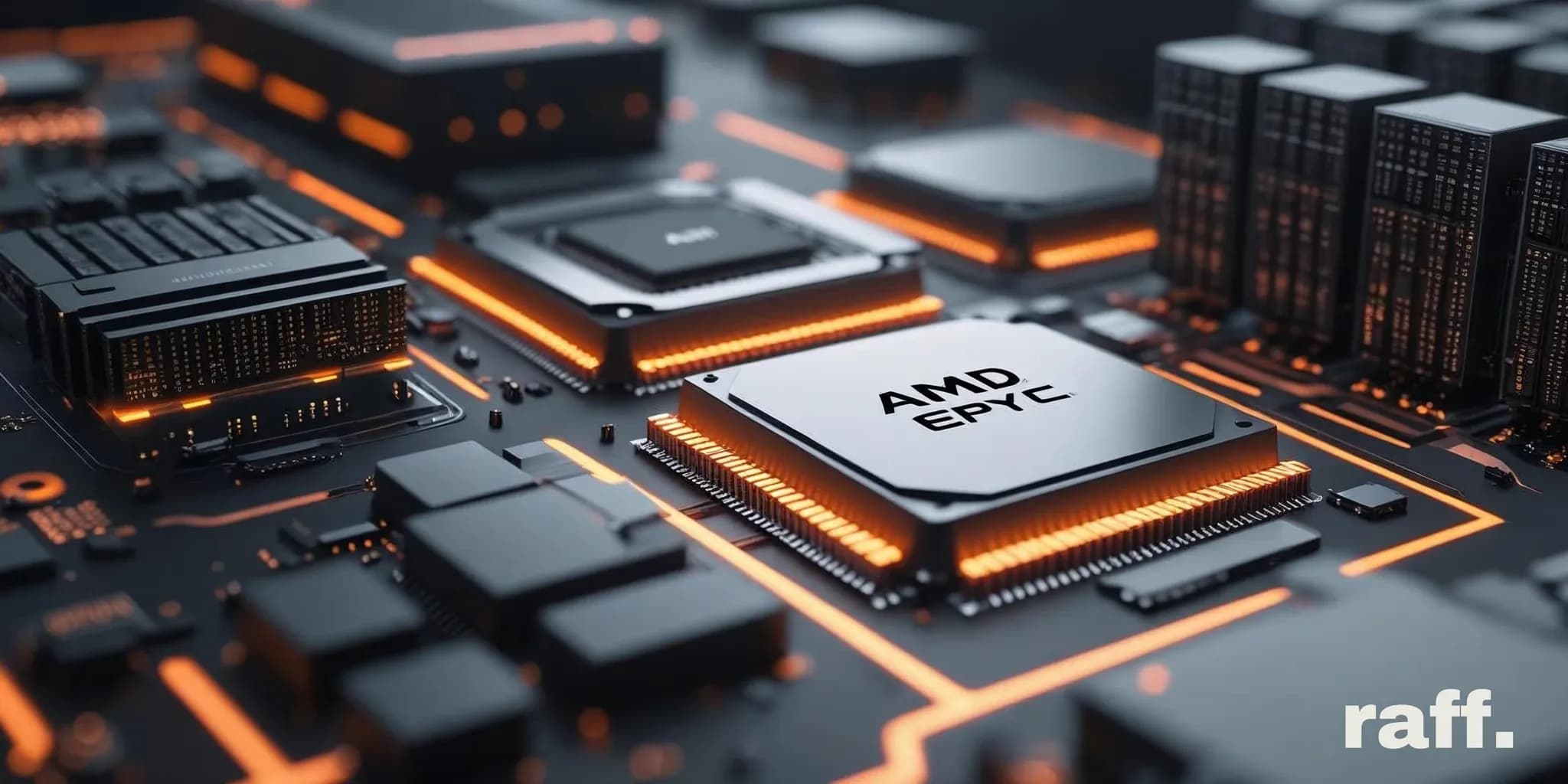
AMD EPYC is part of how we keep Raff consistent
We chose AMD EPYC for Raff Technologies because we wanted one modern CPU foundation across the platform, not a mixed hardware story that changes depending on where a VM lands. For a cloud provider, that matters more than a benchmark screenshot. The processor decision affects pricing discipline, virtualization consistency, and how predictable the platform feels once users move beyond one small server.
A lot of infrastructure vendors talk about CPUs like they are decorative specs. I think that misses the real point. A cloud customer is not buying a chip in isolation. They are buying the experience that sits on top of that hardware: VM responsiveness, stable virtualization behavior, cleaner performance expectations, and a platform that does not quietly shift character between plans or hosts.
That is why this was not a spec-sheet decision for us. It was a platform decision.
We did not want mixed expectations across the product
One of the things I dislike in cloud infrastructure is silent inconsistency.
A platform can look simple from the outside while behaving differently depending on host generation, CPU family, or which hardware pool a workload lands on. That may be operationally normal for some providers, but it creates the wrong experience for users. A developer should not have to wonder whether one VM feels different from another because the provider made a quiet hardware trade-off in the background.
Standardizing on AMD EPYC helped us avoid that kind of fragmentation.
The point was not just modern server performance. The point was to give Raff a cleaner baseline across the platform so Linux VMs, storage-heavy workloads, and everyday development environments all sit on infrastructure chosen with consistency in mind.
CPU choice changes more than raw speed
A lot of people think CPU selection is mostly about “faster” versus “slower.”
In a cloud platform, the decision reaches much further than that.
It affects:
- how well the platform behaves under virtualization,
- how confidently you can define VM tiers,
- how predictable the price-to-performance story stays,
- and whether the infrastructure feels current or patched together.
That is the real reason I think CPU choice deserves a stronger explanation than most providers give it.
At Raff, we are not selling processors. We are selling cloud infrastructure that people use for web apps, databases, containers, CI pipelines, and development environments. The hardware layer should support those workloads cleanly. If it does not, the rest of the stack inherits that weakness.
Virtualization quality mattered more than marketing value
This is the part I care about most.
Raff is built around virtual machines. That means the hardware decision had to make sense specifically in a virtualization-heavy environment. We were not picking a processor because it looked good in a rack spec sheet. We were choosing the foundation underneath the VM experience itself.
That changes the evaluation.
The real question becomes:
- does this hardware support clean VM performance?
- does it fit the platform we want to build?
- does it help the cloud product stay understandable as it grows?
For us, AMD EPYC made sense because it aligned with the kind of virtualization-first platform we wanted to build, not just the kind of marketing sentence we wanted to publish.
The decision was also about economics
This is where hardware and product philosophy meet.
A lot of infrastructure choices look strong technically and weak economically. The hardware may be impressive, but if it pushes the platform toward the wrong pricing logic, the customer eventually pays for that inefficiency.
We did not want that.
We wanted hardware that supported a practical platform — one where the cloud product above it could stay rational, modern, and predictable as we expanded VMs, storage, networking, and protection layers. That is one reason this decision fits the rest of Raff so well. It supports a platform built around AMD EPYC, NVMe-backed infrastructure, fast provisioning, and pricing clarity instead of one where “premium hardware” becomes a separate upsell category later. Raff’s public site already reflects that broader positioning: AMD EPYC, NVMe, fast deployment, and pricing starting from $4.99/month are presented as part of one infrastructure story, not separate premium tiers. (Raff Technologies)
That is the more useful frame: not “which CPU sounds most impressive?” but “which hardware lets us build the right cloud product on top?”
Why this matters to users
A user does not need to memorize EPYC model numbers for this decision to matter.
The practical benefit is that the platform is built on hardware chosen for the right reasons:
- a cleaner VM baseline,
- a more current infrastructure layer,
- stronger alignment with virtualization-heavy workloads,
- and a better long-term performance story for the product above it.
That is also why we do not think of AMD EPYC as a standalone bragging point. It matters together with the rest of the platform: Linux VMs, private cloud networks, data protection, and the broader architecture choices underneath Raff.
The CPU is not the product.
But it absolutely shapes the product.
Why this page exists now
This is also part of why I wanted this post to be more specific than the usual “AMD is powerful” article.
That angle already exists everywhere, including on our own site. The more useful explanation is not that AMD has become important in cloud. The more useful explanation is why we standardized on it for Raff specifically, and what that says about the kind of platform we are building.
That distinction matters for search too.
People searching for AMD EPYC in cloud infrastructure are not only asking whether the processor is good. They are often really asking what that hardware choice means for VM consistency, virtualization, pricing, and long-term platform design.
That is the question I actually wanted to answer.
What This Means for You
If you are evaluating cloud infrastructure, I would look past CPU branding as a decorative spec and ask a more useful question:
What does the processor choice say about the platform behind it?
Does it look like the provider chose hardware that supports a coherent cloud experience, or just something easy to advertise? Does the rest of the stack make sense around that decision? Will the platform still feel predictable when you add storage, networking, backups, and more demanding workloads?
That is the better question.
At Raff, AMD EPYC is not there to make a product page look modern. It is part of a larger infrastructure philosophy: build on current hardware, keep the platform understandable, and let the layers above it grow in the right order. If you want to see how that shows up in practice, start with Linux VMs, then look at how the broader platform connects through object storage, private networking, and data protection.
That is where the decision makes the most sense.
Not as a chip choice in isolation.
As part of the kind of cloud platform we are trying to build.