Kubernetes vs Docker Compose is not a question of which tool is more advanced. It is a question of which operating model your team is ready to run.
Docker Compose is a simple way to define and run multi-container applications, usually from a single compose.yaml file. Kubernetes is a container orchestration platform for running containerized workloads across a cluster, with scheduling, service discovery, self-healing, scaling, and declarative infrastructure controls. Docker describes Compose as a tool to define and run multi-container applications, while Kubernetes describes itself as an open source system for automating deployment, scaling, and management of containerized applications: Docker Compose documentation and Kubernetes documentation.
For Raff Technologies users, the real decision is practical: keep Docker Compose on a Raff VM while one server or a small VM setup is enough, then move toward Kubernetes only when deployment coordination, scaling, service discovery, multi-node scheduling, and operational consistency become real problems.
This guide explains when Docker Compose is enough, when Kubernetes makes sense, what small teams should prepare before moving, and how to connect the decision to the broader Raff infrastructure path: single VM vs multi-VM SaaS architecture, database backup strategy, app uploads on object storage, and Raff VM.
Docker Compose and Kubernetes solve different stages
Docker Compose and Kubernetes are both used with containers, but they solve different problems.
Docker Compose is best when a team wants a simple way to define an app and its supporting services. A single Compose file can describe the app container, database container, Redis container, worker process, networks, volumes, and environment variables.
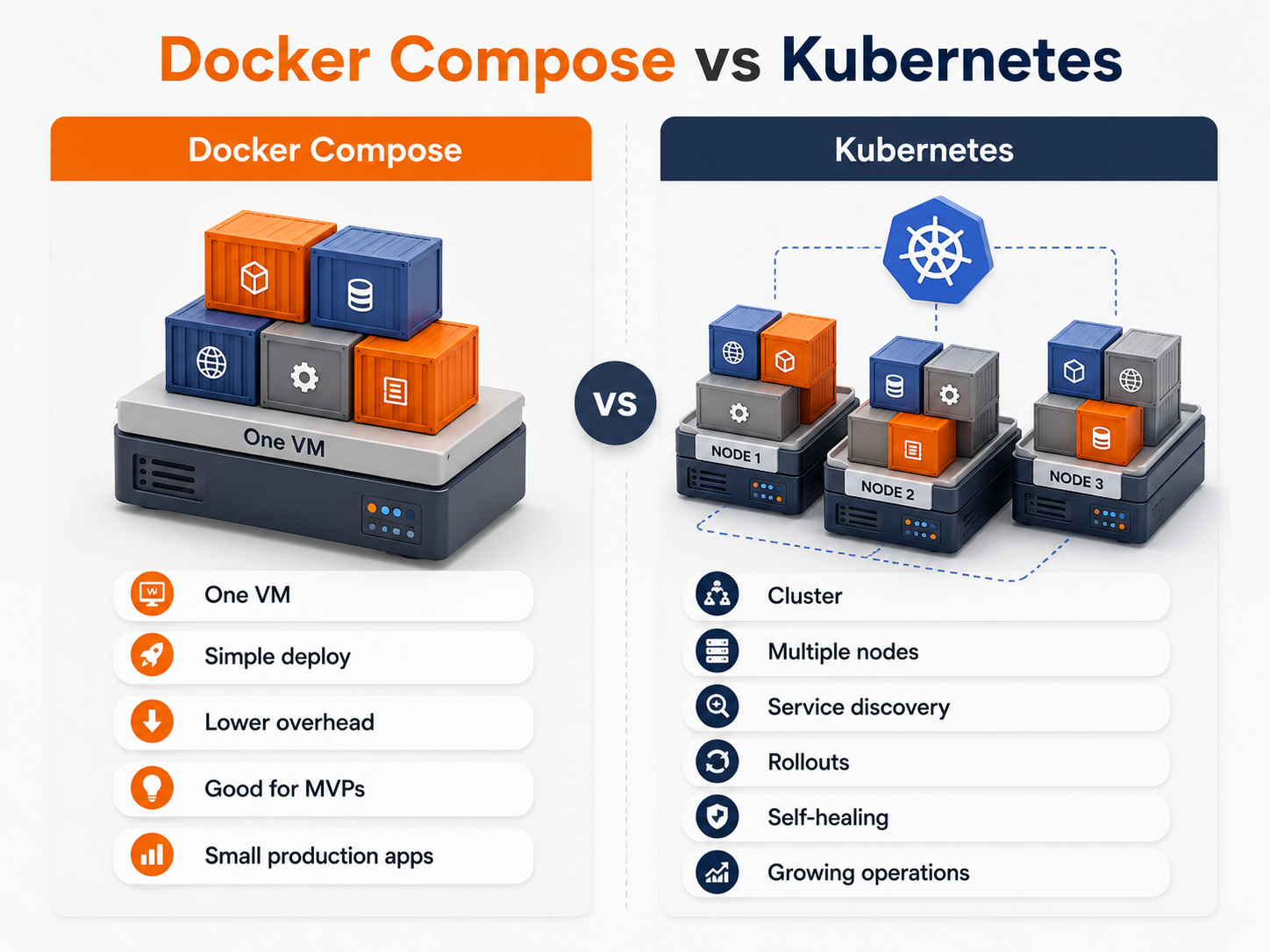 Kubernetes is best when a team needs a cluster-level operating model. It handles workloads across nodes, restarts failed containers, exposes services, manages configuration and secrets, schedules workloads, supports rolling updates, and provides a standard API for cluster operations.
The important difference is not syntax. It is responsibility.
| Area | Docker Compose | Kubernetes |
|---|
| Main unit | One project on one host or small setup | Cluster of workloads across nodes |
| Complexity | Lower | Higher |
| Best stage | Prototype, MVP, small production app | Growing production system with operational needs |
| Deployment model | docker compose up, CI/CD script, or systemd wrapper | Declarative manifests, Helm, GitOps, or cluster deploy pipeline |
| Scaling model | Usually host-level or simple service replicas | Cluster scheduling and workload scaling |
| Networking | Simple app-level container network | Services, ingress, DNS, network policies |
| Self-healing | Limited compared with Kubernetes | Built into workload controllers |
| Team requirement | Basic container operations | Cluster operations, observability, and release discipline |
| Best Raff fit | Raff VM for simple production workloads | Raff Kubernetes path when cluster operations are justified |
Docker Compose is not "unprofessional." Kubernetes is not automatically "better." A small SaaS team needs the tool that matches its stage.
Docker Compose fits simple production workloads
Docker Compose is often enough for early SaaS products.
A typical Compose-based app on a VM might run:
- Web app container
- Reverse proxy container
- PostgreSQL or MySQL container
- Redis container
- Background worker container
- Cron or scheduled job container
- Monitoring or log agent
- Local volumes for state
- Environment file for configuration
This pattern is easy to understand:
Raff VM
  ↓
Docker Compose project
  ↓
App + database + workers + cache
For many small teams, this is the right starting point. It keeps the app close to the server, avoids cluster overhead, and gives developers a predictable deployment model.
Docker Compose fits when:
- You run one production VM
- Traffic is low or predictable
- The app is a monolith or simple service set
- Deployments can happen on one host
- One server failure is acceptable at this stage
- The database is small or managed separately
- The team wants the fewest moving parts
- The business is still validating the product
- You can restore the app from backups and code
- You do not need cluster-level scheduling
Compose also works well for staging, preview, internal tools, demos, and small production apps where simplicity is more valuable than cluster features.
A Raff VM with Docker Compose can be a strong production baseline when it has firewall rules, backups, monitoring, update discipline, and a clear plan for when to split services.
Docker Compose starts to show limits as operations grow
Docker Compose usually breaks down when the app needs more than one server or when different workloads need independent operations.
The warning signs are practical:
- One VM is becoming too large
- App deploys affect workers, database, or cache
- Background jobs slow down web traffic
- App traffic needs multiple servers
- Rollbacks are becoming risky
- Manual SSH deploys are becoming fragile
- Multiple environments drift from each other
- Scaling one service means scaling the whole VM
- A single server failure creates too much downtime
- Developers need consistent deployment across teams
- Workers, app containers, and scheduled jobs need clearer ownership
- Health checks, restarts, and service discovery are becoming manual
These problems do not always mean "move to Kubernetes now."
Often, the next step is a multi-VM architecture first:
Raff VM for app
  ↓
Raff Managed Database
  ↓
Raff Object Storage for uploads
  ↓
Worker VM for background jobs
This is a safer middle path for many SaaS teams. It separates the roles that create the most risk without forcing the team into cluster operations too early.
For this stage, read Single VM vs Multi-VM Architecture for SaaS Apps.
Kubernetes fits when the team needs a cluster operating model
Kubernetes becomes valuable when the team needs a consistent way to operate many containers across multiple nodes.
Kubernetes is not only about running containers. It is about running workloads with a cluster API and operational primitives.
A Kubernetes-based app may use:
- Deployments for stateless app workloads
- Services for stable internal networking
- Ingress for traffic entry
- ConfigMaps and Secrets for configuration
- Horizontal scaling for replicas
- Rolling updates for deployment safety
- Liveness and readiness probes for health checks
- Namespaces for environment or team separation
- Persistent volumes for workloads that require storage
- Network policies for traffic control
- Observability tooling for logs, metrics, and traces
That operating model is powerful, but it comes with responsibility.
Kubernetes fits when:
- The app has multiple services or many containerized workloads
- Deployments need consistent rollout and rollback workflows
- Several app instances need to run across nodes
- Service discovery is becoming important
- The team wants declarative infrastructure workflows
- Self-healing containers reduce operational burden
- Environments need to be standardized
- Traffic or jobs need cluster-level scheduling
- The team has time to monitor and maintain the platform
- The business risk justifies added complexity
Kubernetes should be adopted because it solves a real operating problem, not because it looks more mature in an architecture diagram.
Before Kubernetes, prove you have outgrown VMs
Small teams should prove they have outgrown VMs before moving to Kubernetes.
A single VM can be enough for early products. A multi-VM setup can be enough for many production SaaS apps. Kubernetes becomes the right move only when plain VMs make deployment, scaling, and operations harder than the cluster overhead.
Before Kubernetes, ask:
- Can one larger VM solve the issue for now?
- Can the database be moved to a managed database first?
- Can background workers move to a separate VM?
- Can uploads move to object storage?
- Can a load balancer and two app VMs solve the availability need?
- Can CI/CD improve deployments without Kubernetes?
- Can better monitoring reveal the real bottleneck?
- Can the monolith stay simple while infrastructure roles split?
If the answer is yes, VMs may still be the better path.
A common Raff path is:
Stage 1: One Raff VM
Stage 2: Raff VM + Managed Database
Stage 3: Raff VM + Managed Database + Object Storage
Stage 4: App VM + Worker VM + Database + Object Storage
Stage 5: Load Balancer + multiple app VMs
Stage 6: Kubernetes when cluster operations are justified
This staged path prevents premature Kubernetes adoption.
Kubernetes is not the first scaling step for most small teams. It is the step after VM-based architecture starts creating coordination problems that a cluster is designed to solve.
The quick decision framework
Use this table to decide between Docker Compose, multi-VM infrastructure, and Kubernetes.
| Situation | Better default | Why |
|---|
| Prototype or demo | Docker Compose on one VM | Fastest path with low overhead |
| Early MVP | Docker Compose on Raff VM | Simple deployment and debugging |
| Small production app | Docker Compose + managed database | Keeps app simple while protecting data |
| App has durable uploads | Add object storage | Files should not depend on app VM disk |
| Background jobs affect users | Add worker VM | Jobs should not compete with web traffic |
| One VM is not enough | Multi-VM architecture | Split roles before adopting a cluster |
| Multiple app servers are needed | Load balancer + app VMs | Horizontal scaling without full Kubernetes |
| Many services need coordination | Kubernetes | Cluster-level scheduling and service discovery help |
| Deployments need standard rollout controls | Kubernetes | Declarative updates and health checks reduce manual work |
| Team lacks platform operations capacity | Avoid Kubernetes for now | Cluster complexity can create more risk |
| Environment drift is causing incidents | Kubernetes may help | Standardized manifests and deployment flows can reduce drift |
| Cost clarity matters more than automation | VMs first | VM-based architecture is easier to reason about early |
The best answer is not "always Compose" or "always Kubernetes."
The best answer is the smallest operating model that solves the current production risk.
Cost is not only the infrastructure bill
Kubernetes can reduce operational pain at the right stage, but it also adds cost.
The cost is not only cluster nodes. It includes:
- Cluster design
- Control plane decisions
- Node sizing
- Monitoring
- Logging
- Ingress setup
- Secrets management
- Backup planning
- Upgrade process
- Security policies
- Developer training
- Incident response
- CI/CD changes
- Helm, Kustomize, or GitOps workflow
- More infrastructure concepts for the team to understand
Docker Compose has fewer moving parts. A VM-based architecture is usually easier for a small team to inspect and reason about. Kubernetes can become cheaper in practice only when it replaces enough manual coordination, downtime risk, deployment risk, or scaling friction.
Use this cost question:
Are we paying more in engineering time and operational risk by avoiding Kubernetes than we would pay by adopting it?
If not, stay on VMs.
For deeper planning, read Kubernetes Cost Optimization for Startups and compare infrastructure options on Raff pricing.
Databases should usually stay outside the cluster early
A common mistake is moving the application to Kubernetes and immediately putting the production database inside the cluster.
That is not always the right first move for small teams.
Databases have different recovery, storage, upgrade, and operational requirements than stateless app containers. Running production databases inside Kubernetes can work, but it requires experience with persistent volumes, storage classes, backup operators, restore testing, and operational runbooks.
For many small SaaS teams, the cleaner pattern is:
Kubernetes or app VMs
  ↓ private access
Raff Managed Database
This lets the app benefit from container orchestration while the database stays in a managed service with clearer database operations.
If your team needs full database control, a dedicated database VM can also be a better first step than placing the database inside Kubernetes.
Use Managed vs Self-Hosted Databases and Database Backup Strategy for SaaS Apps before deciding where production data should live.
Uploads should move to object storage before Kubernetes
If app uploads still live on the VM disk, Kubernetes will expose the problem quickly.
Containers are meant to be replaceable. Pods can be rescheduled. Nodes can change. If user files depend on local disk inside one container or one VM path, the architecture is not ready for Kubernetes.
A better pattern is:
Application container
  ↓
Database stores upload metadata
  ↓
Object storage stores uploaded files
Move durable files before moving the app to Kubernetes.
Raff Object Storage is S3-compatible and fits user uploads, exports, reports, media, and backup archives. This gives the app a storage layer that does not depend on one container or one VM.
For the full file decision, read App Uploads: VM Disk vs Object Storage for SaaS Teams.
Docker Compose can still support a production-grade path
A Compose-based setup can be production-grade when the scope is right.
A good Docker Compose production setup should include:
- Versioned Compose file
- Explicit container images or build process
- Reverse proxy and TLS
- Environment variables managed carefully
- Restart policies
- Health checks where supported
- Firewall rules
- Backup plan
- Restore test
- Monitoring
- Log rotation
- Security updates
- Separate database or managed database when needed
- Object storage for durable uploads
- CI/CD process instead of manual edits
- Documented rollback path
The issue is not that Docker Compose is bad. The issue is that Compose does not become a full cluster platform just because the app gets larger.
Treat Compose as the right tool for small production scope. Treat Kubernetes as the next operating model when that scope is exceeded.
Kubernetes readiness requires more than container images
Being containerized does not mean being Kubernetes-ready.
Before moving from Docker Compose to Kubernetes, check these areas:
- The app can run multiple replicas safely.
- Sessions do not depend on one container.
- Uploads are stored outside local container disk.
- Background workers are defined separately from web containers.
- Scheduled jobs do not accidentally run multiple times.
- The database is externalized or intentionally managed.
- Configuration can be expressed through manifests or charts.
- Secrets are handled safely.
- Health endpoints exist.
- Readiness and liveness checks make sense.
- Logs go to a central place.
- Metrics are visible.
- The deployment process can roll forward and roll back.
- The team understands namespaces, services, ingress, and workload controllers.
- Backup and restore plans exist for stateful parts.
Kubernetes rewards preparation. Without it, the team may move the same problems into a more complex environment.
A practical migration path from Docker Compose to Kubernetes
Move gradually. Do not turn a simple production app into a cluster migration project without a clear reason.
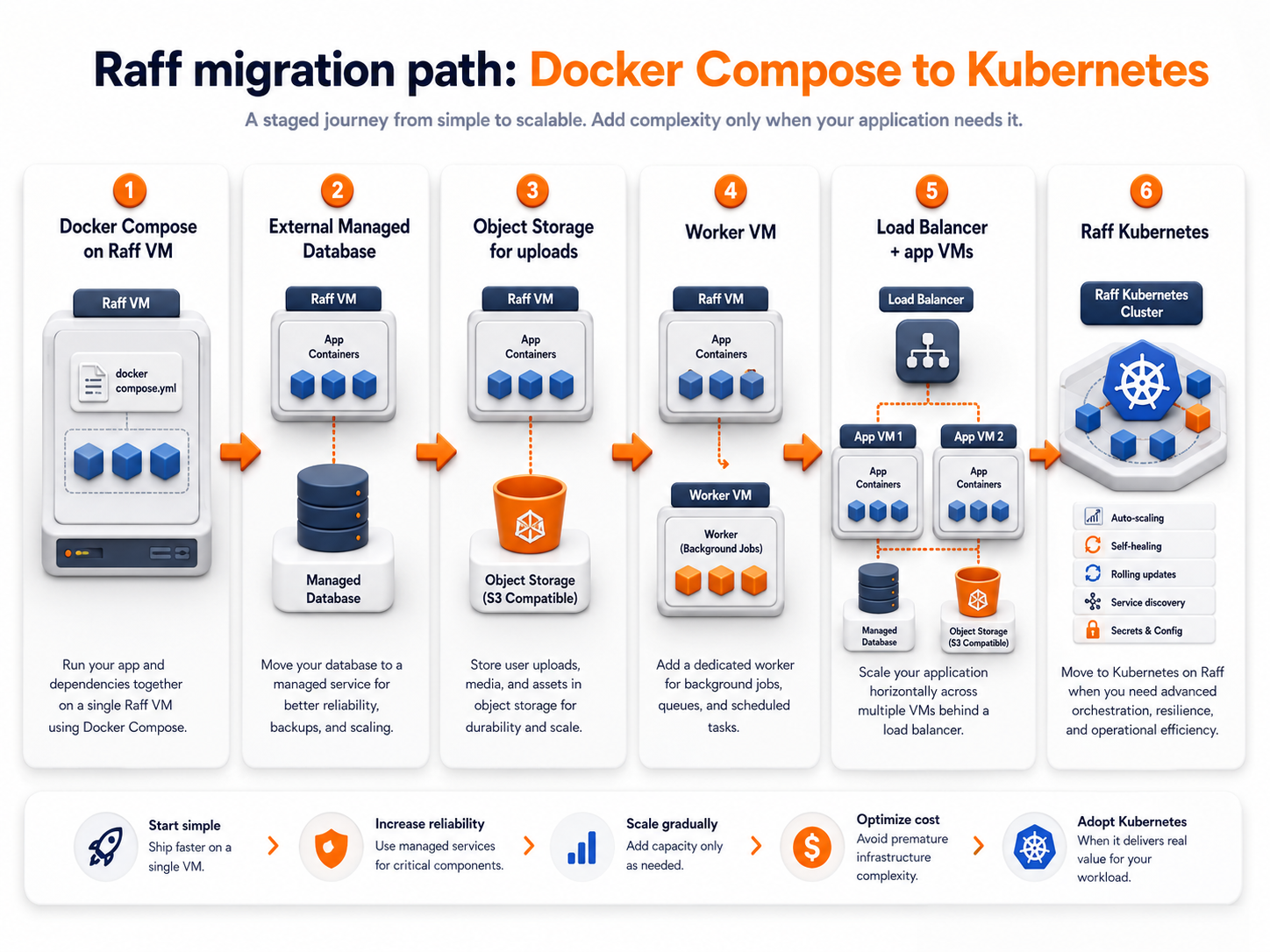
Stage 1: Docker Compose on one VM
Start with a simple, documented Compose setup.
Raff VM
  ↓
Docker Compose
  ↓
App + database + worker + cache
This works for prototypes, MVPs, staging, and small production apps.
Stage 2: Externalize the database
Move production data out of the Compose host.
Raff VM running app containers
  ↓ private access
Raff Managed Database or database VM
This reduces data risk before application scaling.
Stage 3: Externalize uploads
Move durable files to object storage.
App container
  ↓
Raff Object Storage
This makes app containers easier to replace and prepares for multiple app instances.
Stage 4: Split workers
Move background jobs away from web traffic.
App VM
  ↓
Worker VM
  ↓
Managed Database + Object Storage
This may still use Docker Compose on each VM.
Stage 5: Add load balancing if needed
If the app needs more capacity before Kubernetes, use multiple app VMs behind a load balancer.
Users
  ↓
Load balancer
  ↓
App VM 1 + App VM 2
  ↓
Managed Database + Object Storage
This can solve many SaaS scaling problems without Kubernetes.
Stage 6: Move to Kubernetes when coordination becomes the bottleneck
Move to Kubernetes when managing app replicas, deployments, services, rollbacks, scheduling, and environment consistency across VMs becomes harder than operating a cluster.
Kubernetes cluster
  ↓
App workloads + workers + services
  ↓
Managed Database + Object Storage
This is the point where Kubernetes starts earning its complexity.
Raff path: VM first, Kubernetes when it earns its place
Raff's infrastructure path should feel staged, not forced.
A small team can begin with a Raff VM and Docker Compose. When the app grows, the team can separate the database, move uploads to object storage, split workers, and add load balancing. Kubernetes becomes the later step when the team needs cluster-level operations.
A practical Raff product path looks like this:
Raff VM
  ↓
Raff Managed Database
  ↓
Raff Object Storage
  ↓
Worker VM or more app VMs
  ↓
Raff Kubernetes when orchestration is justified
This path supports teams that want to launch quickly without being trapped in a fragile single-server setup.
Use:
This is the Raff-specific principle: do not buy complexity before the workload proves it.
The pre-Kubernetes checklist
Before moving a small team from Docker Compose or VM-based deployment to Kubernetes, review this checklist.
If this checklist feels heavy, that is the point. Kubernetes can help, but it also becomes part of the system your team must operate.
Common mistakes to avoid
Moving to Kubernetes because it feels more advanced
Kubernetes should solve a real operational problem.
If one VM or a small multi-VM architecture still works, Kubernetes may add complexity before it adds value.
Putting production data into Kubernetes too early
Databases need serious backup, restore, storage, and upgrade discipline.
Small teams should often use a managed database or dedicated database VM before running stateful production databases inside Kubernetes.
Keeping uploads on local disk
Local upload storage blocks container replacement and multi-node scheduling.
Move durable files to object storage before Kubernetes.
If deployments are messy because CI/CD is weak, Kubernetes will not automatically fix the process.
Improve build, release, rollback, and configuration discipline first.
Ignoring observability
Kubernetes without logging, metrics, alerts, and health checks creates a bigger black box.
Observability should be part of the migration, not an afterthought.
Splitting the codebase too early
Kubernetes does not require microservices.
A monolith can run on Kubernetes. Split infrastructure operations before splitting the application into many services.
Underestimating team learning cost
Kubernetes adds concepts: pods, deployments, services, ingress, namespaces, secrets, config maps, volumes, RBAC, and cluster upgrades.
Make sure the team is ready to own those concepts.
Docker Compose vs Kubernetes comes down to operating model
Docker Compose is the right choice when a small team needs a simple, understandable way to run a containerized app on one VM or a small setup.
Kubernetes is the right choice when the team has outgrown VM-level coordination and needs cluster-level scheduling, service discovery, rollout controls, self-healing, and consistent operations across workloads.
Most SaaS teams should not jump directly from first VM to Kubernetes. A better path is staged: start with Docker Compose on a Raff VM, externalize the database, move uploads to object storage, split workers, add load balancing when needed, and move to Kubernetes only when the operating model is worth the complexity.
Next, read Single VM vs Multi-VM Architecture for SaaS Apps, Database Backup Strategy for SaaS Apps, and Kubernetes Cost Optimization for Startups.
Then compare Raff VM, Raff Managed Databases, Raff Object Storage, Raff Kubernetes, and Raff pricing to choose the next infrastructure step your team can operate safely.
