
Kubernetes multi-tenancy lets multiple teams or customers share Kubernetes infrastructure while isolation controls limit what each tenant can access, consume, and affect. The important decision is not simply whether to use one namespace per customer. It is how much of the control plane, worker capacity, network, storage, and administrative surface each tenant should share.
For MSPs, the practical architecture usually falls into three service models: shared cluster with namespace isolation, shared control plane with dedicated worker capacity, or a dedicated cluster per client. The right model depends on tenant trust, Kubernetes access, noisy-neighbor risk, workload sensitivity, recovery boundaries, and what the customer is actually paying to have isolated.
At Raff Technologies, this distinction is useful because Raff Managed Kubernetes supports multiple worker pools inside a cluster as well as separate clusters. That gives MSPs a clear path from shared infrastructure to stronger client boundaries without pretending that every customer needs the same level of isolation.
This guide owns the Kubernetes multi-tenancy decision for MSPs: namespace isolation, RBAC, NetworkPolicy, ResourceQuota, Pod Security, worker-pool isolation, dedicated clusters, hard multi-tenancy limits, and cost allocation.
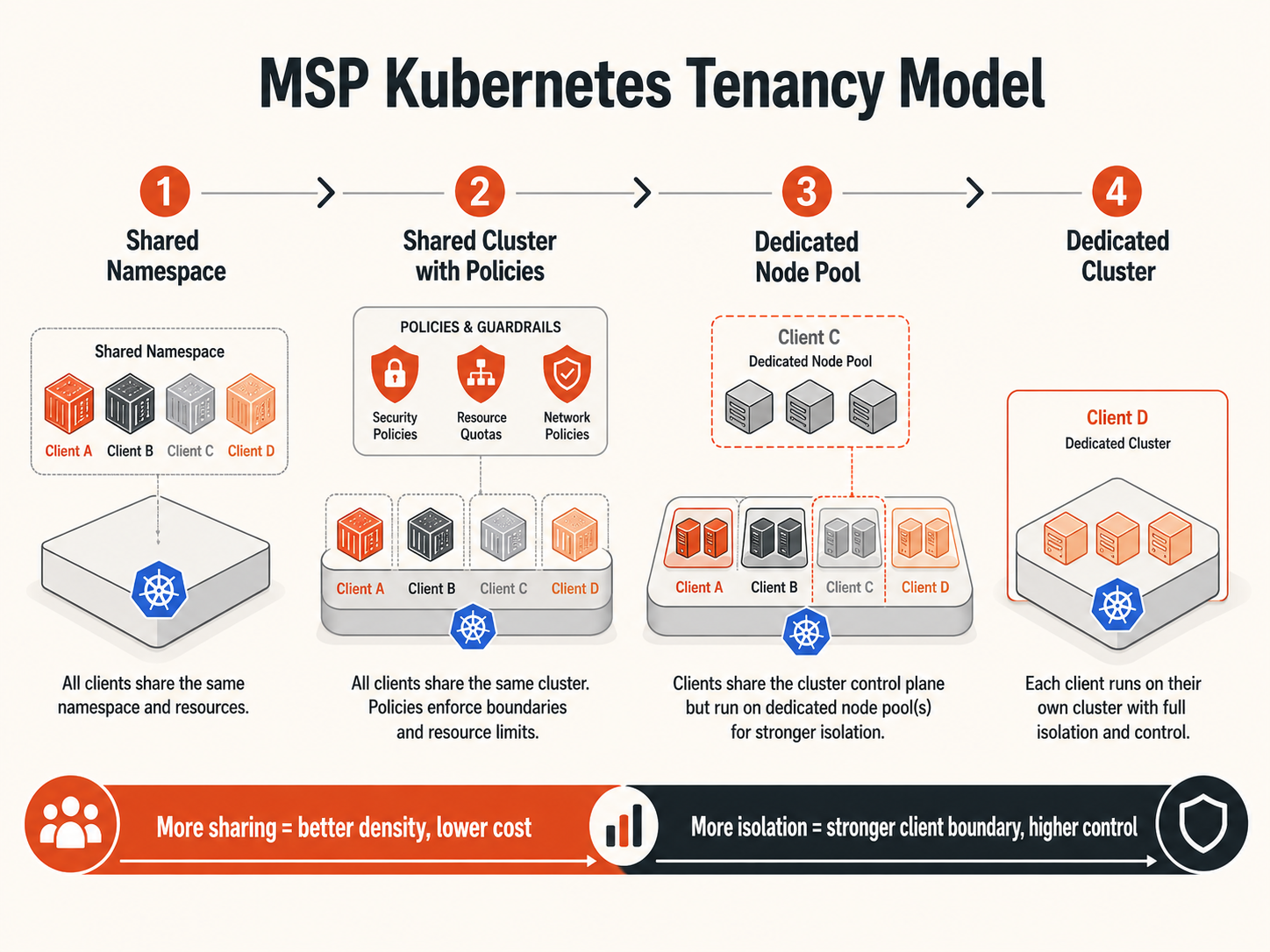
Kubernetes multi-tenancy at a glance
Kubernetes does not have one first-class tenant object. Instead, cluster operators combine namespaces, access controls, network policy, quotas, workload security, scheduling, and sometimes separate control planes to create the isolation level the business needs.
| Service model | Control plane | Worker capacity | Tenant Kubernetes access | Best fit |
|---|---|---|---|---|
| Shared cluster + namespace policies | Shared | Shared | Scoped | Standardized workloads with controlled access |
| Shared cluster + dedicated worker pool | Shared | Dedicated or reserved by placement | Scoped | Performance-sensitive or higher-value clients |
| Dedicated cluster | Dedicated | Dedicated | Can be broader | Sensitive clients, broad admin needs, divergent policy |
A virtual control plane per tenant can sit between shared namespaces and dedicated clusters, but it adds another platform layer and does not remove data-plane isolation requirements.
Sell the boundary you actually operate.
A higher-isolation service tier should correspond to a real change in worker placement, control-plane ownership, network boundary, or recovery model.
What does multi-tenancy mean in Kubernetes?
Kubernetes multi-tenancy is the practice of sharing a cluster or part of a Kubernetes platform between distinct tenants while controlling access and interference.
A tenant may be one MSP customer, one customer environment, one internal engineering team, one product group, or one dedicated application instance.
For MSPs, direct Kubernetes access changes the threat model. A tenant that can create workloads, inspect Secrets, alter policies, or request cluster-scoped objects needs a stronger boundary than a customer that never touches the Kubernetes API.
Namespace isolation is the normal shared-cluster starting point
Namespaces provide the main logical boundary inside one Kubernetes control plane. They scope many resources and many policy mechanisms, including Roles, RoleBindings, NetworkPolicies, ResourceQuotas, Secrets, ConfigMaps, Services, Deployments, and Pods.
A namespace-per-tenant model can work well when:
- tenants do not need cluster-admin access;
- tenants do not control cluster-scoped resources;
- workloads can follow one shared platform policy;
- network access can be constrained cleanly;
- resource usage can be bounded;
- the MSP owns the cluster lifecycle.
But a namespace is not a complete security boundary by itself.
Nodes, PersistentVolumes, StorageClasses, CustomResourceDefinitions, admission webhooks, and other cluster-scoped resources sit outside namespace isolation. Kubernetes also permits broad pod-to-pod communication unless NetworkPolicy and a compatible network implementation restrict it.
Shared clusters need five isolation layers together
1. RBAC limits control-plane access
Use least-privilege RBAC and prefer namespace-scoped Roles and RoleBindings where possible. Avoid broad wildcard permissions and avoid giving shared-cluster tenants cluster-admin.
Treat these permissions as high-risk in a multi-tenant cluster:
- reading, listing, or watching Secrets;
- creating privileged Pods;
- creating arbitrary workloads under powerful service accounts;
- editing admission or cluster-wide policy;
- creating cluster-scoped resources;
- broad impersonation rights.
2. NetworkPolicy limits east-west traffic
For tenants that should not communicate, begin with deny-by-default network policy and add only required flows.
Tenant namespace
  → DNS: allowed
  → own application services: allowed
  → approved shared platform service: allowed
  → other tenant namespaces: denied
  → management namespaces: denied
NetworkPolicy enforcement depends on the cluster networking implementation, so policy must be tested rather than assumed.
3. ResourceQuota and LimitRange reduce noisy-neighbor risk
A shared cluster needs a defined resource envelope per tenant. ResourceQuota can limit namespace-level CPU, memory, object counts, and selected storage usage. LimitRange can establish defaults and boundaries for individual workload resources.
For an MSP service tier, define CPU and memory requests, limits where appropriate, selected object or Pod counts, storage boundaries, quota alerts, and an escalation rule when the tenant outgrows the shared tier.
Quotas improve fairness, but they are not complete performance isolation. Tenants can still contend for node-level CPU, memory bandwidth, storage I/O, networking, and shared platform components.
4. Pod Security limits dangerous workload capabilities
A tenant that can run ordinary application Pods has a different risk profile from one that can run privileged containers, mount host paths, or use powerful host capabilities.
Use Pod Security controls that match the tenant trust level. Exceptions should be deliberate and documented rather than inherited from a permissive cluster default.
5. Storage needs explicit tenant ownership
PersistentVolumeClaims are namespaced, but the wider storage system is not automatically tenant-isolated.
Document volume ownership, allowed StorageClasses, reclaim behavior, backup ownership, restore permissions, encryption requirements, and whether one client can affect another through shared storage throughput.
Soft multi-tenancy vs hard multi-tenancy
The phrase hard multi-tenancy is often used for environments where tenants are mutually untrusted and require stronger isolation. Kubernetes provides building blocks rather than one universal hard-tenancy switch.
A useful MSP model is:
Logical isolation
namespace + RBAC + NetworkPolicy + quota

Placement isolation
logical controls + dedicated worker pool

Control-plane isolation
separate or virtual control plane

Full simple boundary
dedicated cluster + dedicated workers
A shared namespace model can be appropriate for trusted or controlled workloads. It becomes harder to defend when customers need broad Kubernetes privileges, custom admission behavior, cluster-scoped resources, or different platform policies.
Dedicated clusters are not automatically secure. They still need RBAC, network policy, Pod Security, patching, backups, observability, and recovery design. Their main benefit is reducing the amount of infrastructure and policy shared between customers.
When a dedicated worker pool is enough
A separate worker pool is useful when the tenant can share the control plane but should not share general worker capacity.
That is a strong middle tier when:
- one customer creates persistent noisy-neighbor problems;
- the customer buys reserved capacity;
- workloads need a different machine class;
- support needs clearer resource attribution;
- a customer requires stronger placement separation;
- workload scaling should not consume another tenant's worker pool.
A dedicated pool can use labels, taints, tolerations, and affinity rules to keep workloads on the intended nodes.
Dedicated worker nodes are not a dedicated Kubernetes cluster. The control plane, cluster-scoped resources, API server, and some shared platform components still belong to the same cluster.
Use Kubernetes Node Pools: Workload Separation and Scaling for the deeper placement and autoscaling decision.
When a client should get a dedicated cluster
Move a tenant to a dedicated cluster when one or more of these conditions becomes important:
- the customer needs broad Kubernetes administrative access;
- the customer must create or modify cluster-scoped resources;
- cluster-wide policies need to differ materially;
- upgrade timing must diverge from other customers;
- a security or contractual requirement rejects a shared control plane;
- incident response must be isolated from other tenants;
- backup or recovery ownership needs a dedicated cluster boundary;
- customer-specific operators or webhooks create shared-cluster risk.
The decision should not be based only on customer size. A small sensitive workload may need a dedicated cluster, while a larger standardized application may remain suitable for a shared environment.
Virtual control planes are an intermediate option
Virtual control planes can give each tenant a separate Kubernetes API and control-plane state while workers remain part of a shared underlying platform.
This can help when tenants need Kubernetes API autonomy but fully dedicated clusters create too much operating overhead. It also introduces another platform layer and does not solve worker-node noisy neighbors or all data-plane security problems.
For many small MSPs, shared namespaces, dedicated worker pools, and dedicated clusters are easier service tiers to explain and support.
Cost control should follow the tenant boundary
Shared Kubernetes can improve infrastructure utilization, but margin becomes difficult to manage when client usage is not attributable.
Separate three concepts:
- requested capacity — what the scheduler and platform reserve around;
- actual usage — what the workload consumes over time;
- isolation cost — infrastructure and operations dedicated to one customer.
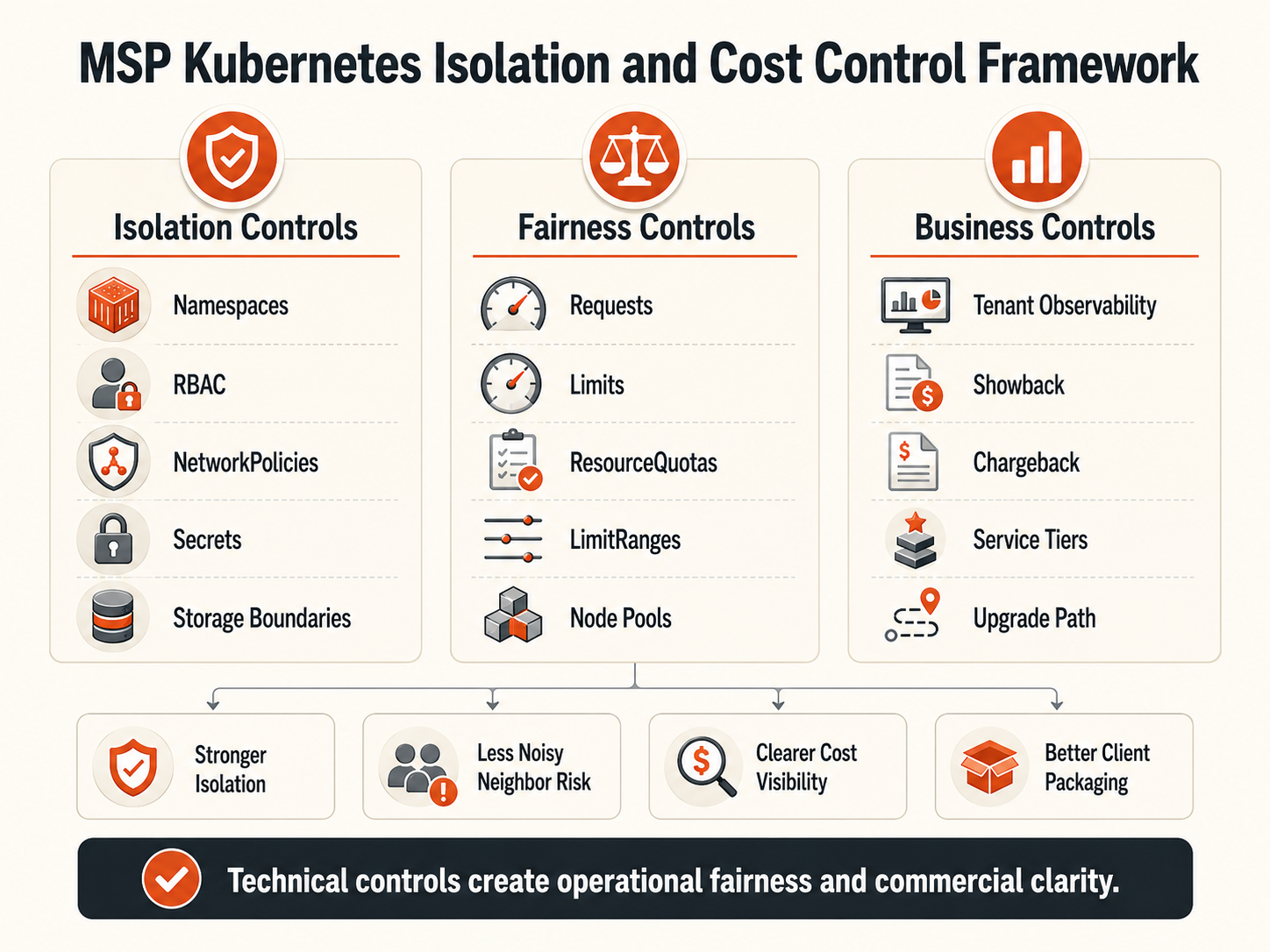
| MSP tier | Architecture boundary | Commercial logic |
|---|---|---|
| Shared | Namespace + policy controls | Shared infrastructure allocation |
| Isolated compute | Dedicated worker pool | Reserved or dedicated worker capacity |
| Dedicated | Separate Kubernetes cluster | Separate cluster and operating boundary |
This is more defensible than inventing arbitrary premium pricing while the technical architecture remains identical.
For cluster-level allocation and rightsizing, use Kubernetes Cost Optimization: Reduce Cluster Spend.
Observability must stay tenant-aware
In a multi-tenant platform, logs and metrics can become another cross-tenant data path.
Define who can query each tenant's logs, how dashboards are scoped, whether one tenant can enumerate another tenant's workload names, retention by service tier, alert ownership, and audit access for MSP administrators.
A shared monitoring stack can still be appropriate, but access controls and query boundaries must be deliberate.
Backups and recovery are part of tenancy design
For each service tier, define application-data backup ownership, PersistentVolume recovery, cluster configuration recovery, tenant-specific restore procedures, who can request a restore, whether one tenant's restore can affect others, and how a dedicated cluster is recreated after failure.
Shared infrastructure can be efficient, but recovery should not become an improvised cross-customer operation.
Use Kubernetes Backup and Disaster Recovery Strategy for the deeper recovery layer.
A practical MSP decision framework
Use a shared cluster when
- workloads are standardized;
- the MSP controls deployment policy;
- namespace-scoped access is enough;
- customers do not require cluster-scoped administration;
- one shared upgrade policy is acceptable;
- quotas and network policy can express the required boundary.
Use a dedicated worker pool when
- the control plane can remain shared;
- compute capacity should be reserved or isolated;
- performance variability is creating support risk;
- the customer needs a different worker size or scaling policy;
- cost attribution needs a clearer compute boundary.
Use a dedicated cluster when
- the customer needs broader Kubernetes administration;
- control-plane sharing is unacceptable;
- cluster-scoped policy differs;
- security, contractual, or recovery requirements call for stronger separation;
- the customer needs independent lifecycle decisions.
The strongest MSP architecture is usually not maximum tenant density. It is the lowest-cost boundary that remains easy to explain, operate, secure, and recover. For a direct service-model comparison, see Shared Cluster vs Per-Client Cluster for MSPs.
How Kubernetes multi-tenancy maps to Raff
Raff Managed Kubernetes supports multiple worker pools inside a cluster and separate clusters when a customer needs a stronger boundary. Worker pools can autoscale between configured minimum and maximum node counts.
That creates a practical Raff service ladder:
Standard tenant
shared Raff Kubernetes cluster
+ namespace isolation
+ RBAC / NetworkPolicy / quotas

Higher-isolation tenant
shared Raff control plane
+ dedicated worker pool
+ explicit placement and capacity policy

Dedicated tenant
dedicated Raff Kubernetes cluster
+ separate cluster VPC
+ separate lifecycle boundary
Raff currently lists the standard Kubernetes control plane at $0/month, with an optional three-master HA control plane at $30/month. Worker pricing is separate. The Kubernetes service also provides private cluster networking and a managed public endpoint.
For MSP economics, a dedicated cluster can be sold as a real operating boundary: separate cluster lifecycle, separate worker capacity, separate VPC, and a clearer incident surface.
Do not oversell what worker-pool separation provides. A separate pool improves placement and compute attribution, but the cluster control plane remains shared. When the customer's requirement is control-plane isolation, use a dedicated cluster.
Product details reviewed: 2026-09-16. Check Raff Kubernetes and Raff Pricing before quoting customer pricing because plans can change.