
A local server is physical hardware that runs inside a business location, while a cloud server is a virtual machine hosted in a data center and accessed over a network.
For a small business, the choice affects much more than where the server sits. It changes who owns hardware failures, how employees connect remotely, how backups are handled, how quickly capacity can change, and what happens when the office loses power or internet access. Raff Technologies supports 3,000+ customers and 15,000+ VMs, so the local-versus-cloud decision appears in the same practical context as many other small-team infrastructure choices: reduce the failure modes the business is least equipped to operate.
This guide anchors Raff’s Cloud Servers for Small Business cluster. It explains when local infrastructure still makes sense, when a cloud server is the stronger choice, and how to compare access, cost, security, recovery, maintenance, and control before moving a business workload.
Local and cloud servers shift different responsibilities
A local server lives inside the business. The company owns or leases the physical machine, powers it, cools it, connects it to the office network, replaces failed components, and decides how off-site backups are handled.
A cloud server removes most of that physical responsibility. The provider operates the underlying facility and hardware, while the customer still owns the operating system, applications, accounts, firewall rules, data, patching, and recovery choices that sit above the infrastructure layer.
That distinction is the real trade-off.
| Responsibility | Local server | Cloud server |
|---|---|---|
| Physical hardware | Business or MSP | Cloud provider |
| Power and cooling | Business | Cloud provider |
| Internet connectivity | Business | Shared between provider and customer access path |
| Operating system | Business | Business |
| Application maintenance | Business | Business |
| User access | Business | Business |
| Backups and restore testing | Business | Business, with provider tools available |
| Capacity expansion | Hardware upgrade | Resize or add resources |
Moving to the cloud does not remove operational responsibility. It removes the need to own and maintain the physical server itself.
For many SMBs, that is valuable because the business never wanted to maintain hardware. It wanted a dependable place to run a website, accounting system, internal application, database, remote desktop environment, or shared service.
Local servers remain right for office-bound workloads
Local infrastructure is still a good fit when the workload is tightly coupled to the physical office.
Examples include:
- manufacturing or warehouse equipment that communicates over the local network;
- security systems, scanners, or specialized devices that expect local connectivity;
- very large media or engineering files used almost entirely inside one office;
- applications with hardware dongles or dependencies that cannot be moved safely;
- locations where internet connectivity is unreliable but the workload must continue offline.
A local server also makes more sense when the business already has healthy hardware, reliable on-site IT support, tested backups, and no strong need for remote access.
The stronger local-server profile looks like this:
| Signal | Why local can still fit |
|---|---|
| Workload is office-only | Remote reachability adds little value |
| Physical equipment is required | Moving compute may break the workflow |
| Large files stay on the LAN | Local network throughput matters |
| Internet outages are common | Local services can continue offline |
| On-site IT is available | Hardware and recovery have clear owners |
The weak case is keeping an aging server only because “it still works.” A server with no documentation, no tested restore process, unsupported software, or one person who knows how it is configured is an operational dependency, not a cost saving.
If the business is already facing hardware replacement, read Office Server Replacement Guide: What SMBs Should Move First before buying another physical machine.
Cloud servers fit remote and shared workloads
Cloud infrastructure becomes more attractive when a workload must be reachable beyond one office or must recover without depending on one physical location.
Common cloud-server triggers include:
- employees or contractors need access from multiple locations;
- an MSP or IT consultant manages the workload remotely;
- the business runs a website, API, database, dashboard, or hosted business application;
- office power or hardware failure would stop important work;
- CPU, RAM, or storage needs may change over time;
- replacing server hardware would be disruptive or difficult to budget;
- the company wants a predictable monthly infrastructure cost instead of periodic hardware purchases.
A useful operational threshold is not an exact employee count. It is dependency. If a shared workload can stop billing, customer support, sales, order processing, or staff productivity, the business should treat it as production infrastructure regardless of whether three people or thirty people use it.
Cloud servers are also easier to combine with other hosted services. A small business can separate an application server from its database, place uploaded files in object storage, or use managed backups without buying more office hardware.
For common business workloads, see When Small Businesses Need a VPS: 9 Practical Use Cases.
The decision framework compares six operating factors
The right choice depends on the workload rather than a general preference for “on-premises” or “cloud.”
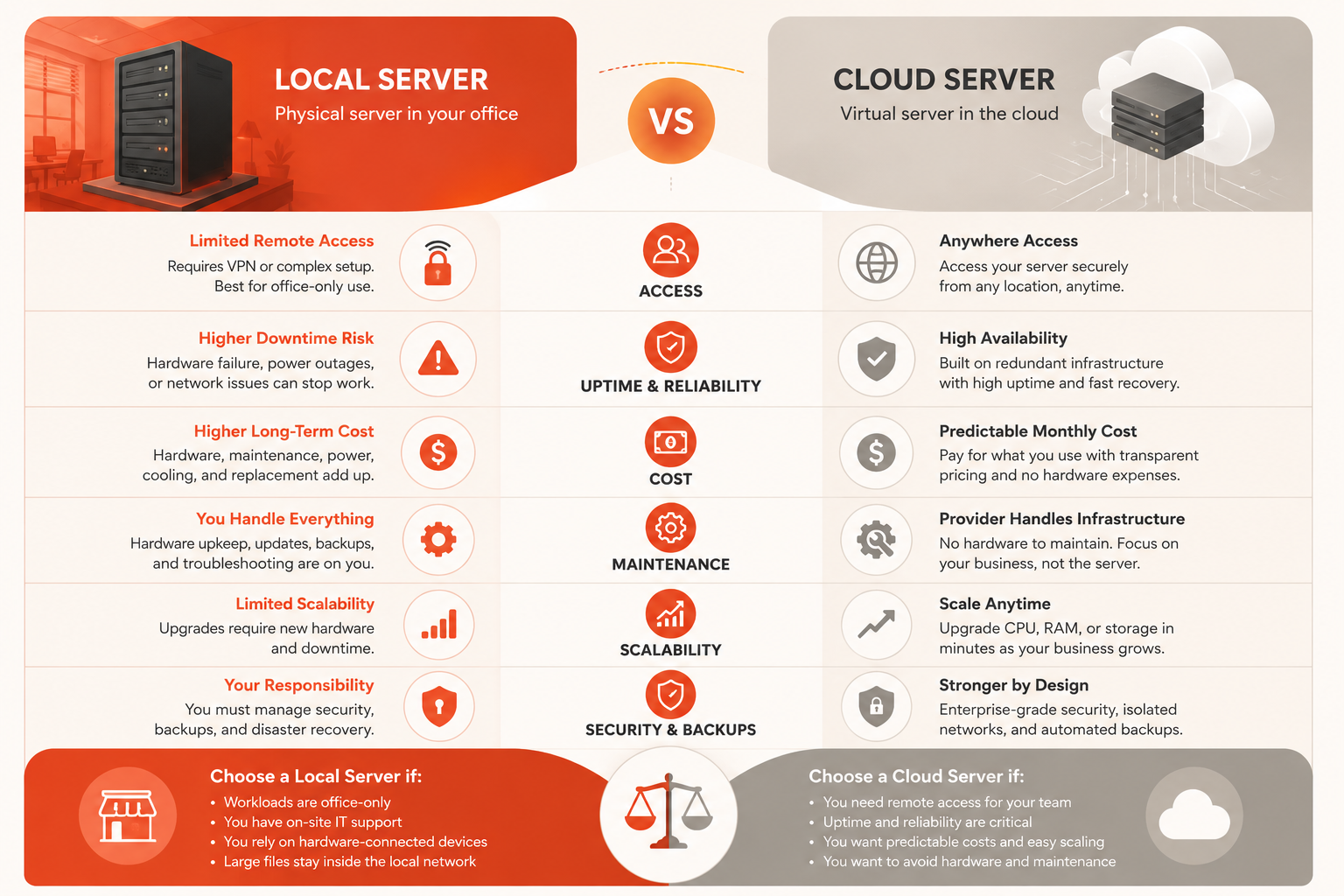
Use these six factors to make the decision.
| Factor | Local server is stronger when... | Cloud server is stronger when... |
|---|---|---|
| Access | Work happens mainly in one office | Users connect from multiple locations |
| Hardware dependency | Physical devices are part of the workflow | Workload is software-defined |
| Maintenance | On-site IT already manages hardware well | Business wants to remove hardware maintenance |
| Scaling | Capacity is stable for years | CPU, RAM, or storage may change |
| Recovery | Office recovery is already tested | Rebuilding away from office hardware is valuable |
| Cost model | Existing hardware still has useful life | Predictable recurring spend is preferred |
Choose a local server if:
- the workload depends on local equipment;
- remote access is secondary;
- the office can operate and recover the hardware reliably;
- current hardware is healthy and documented;
- local network performance matters more than internet reachability.
Choose a cloud server if:
- users need secure access from outside the office;
- the workload should not depend on one building;
- server hardware is aging or due for replacement;
- the business wants flexible sizing;
- a remote IT provider or MSP manages the system;
- recovery from physical failure needs to be simpler.
One numeric check is especially useful: compare the infrastructure decision against the cost of one business day of downtime. If one day offline costs more than the annual difference between two infrastructure options, price alone should not drive the decision.
Cost should include downtime and replacement cycles
A local server can look inexpensive when the hardware is already paid for. That is only part of the total cost.
Local infrastructure can include:
- server purchase or lease;
- replacement disks and components;
- UPS and power protection;
- power and cooling;
- office networking;
- backup storage;
- on-site support;
- periodic hardware replacement;
- emergency repair;
- downtime during local power, network, or hardware incidents.
Cloud infrastructure makes more of the cost visible:
- VM plan;
- attached storage if required;
- backups or snapshots;
- Windows licensing where applicable;
- monitoring or management work;
- migration and support effort.
Neither model is automatically cheaper.
A local server can be economical when it is already owned, well maintained, and tightly matched to an office-only workload. A cloud server can be more economical when it avoids a hardware refresh, reduces on-site support, or lets the business buy only the capacity required today.
Raff Linux VM plans currently start at $4.99/month and include NVMe storage, unmetered bandwidth, and a 3 Gbps port on VM plans. That entry price is useful for small hosted workloads, but a business should compare the full configuration it actually needs rather than the smallest advertised plan.
For a broader cost model, read Cloud Server Cost in 2026.
Security and recovery depend on ownership
A server is not secure because it is inside an office, and it is not secure because it is in a data center.
Security depends on controls such as:
- named administrator accounts;
- MFA where available;
- patching and software lifecycle management;
- restrictive firewall rules;
- secure remote administration;
- credential and key management;
- logging and access reviews;
- isolated backups;
- tested restore procedures.
Local infrastructure creates physical risks such as theft, disk failure, fire, water damage, and office power loss. Cloud infrastructure creates different risks: exposed admin ports, weak account security, poor firewall rules, forgotten public services, or misconfigured backups.
Recovery is where the difference often becomes clearer. Ask these questions for either model:
- Where is the authoritative data?
- How often is it backed up?
- Is the backup independent from the server being protected?
- Who can perform a restore?
- When was the restore process last tested?
- How long can the business operate without the workload?
A cloud provider can supply backup and snapshot tools, but the customer still decides what must be protected and whether the recovery process actually works.
Migration should start with one workload
Replacing a local server does not require moving everything at once.
Start with the workload that has the clearest business case and the fewest physical dependencies. Good early candidates often include:
- a website;
- internal dashboard;
- remote desktop environment;
- hosted database-backed application;
- self-hosted business software;
- development or test infrastructure.
More complex candidates may include old file servers, legacy line-of-business applications, or systems with undocumented permissions and physical-device dependencies.
Before migrating, document:
| Question | Required answer |
|---|---|
| What is moving? | One named workload or server role |
| Who uses it? | Known staff, customers, or systems |
| What data matters? | Files, database, settings, credentials |
| Acceptable downtime? | Defined maintenance window |
| Rollback path? | Known way back to the original system |
| Owner after migration? | Named employee, consultant, MSP, or technical lead |
For a structured cutover process, use the Cloud Migration Checklist for Small Teams.
Raff fits businesses that need a server without hyperscaler complexity
Raff is most relevant when a small business has already decided it needs a server-like environment but does not want to operate physical office hardware or navigate a large hyperscaler catalog.
Raff supports Linux and Windows VMs for workloads such as websites, internal applications, remote desktops, business software, databases, development environments, and self-hosted tools. Current Raff VM plans use NVMe storage, unmetered bandwidth, and 3 Gbps ports, with Linux VM pricing starting at $4.99/month.
The important fit question is the workload:
- Choose a Linux VM for web applications, APIs, open-source software, automation, and many database workloads.
- Choose a Windows VM when the application requires Windows Server, RDP, IIS, .NET, or Windows-only business software.
- Keep a workload local when it genuinely depends on local hardware or must continue through an office internet outage.
- Keep SaaS when a hosted application already solves the business problem without server ownership.
Raff’s role is not to make every SMB workload a VM. It is to provide a straightforward cloud-server option when a VM is the right operating model. With 3,000+ customers and 15,000+ VMs, the platform is designed around predictable infrastructure rather than forcing small teams into enterprise cloud complexity.
If you are still deciding whether a workload belongs on SaaS or self-hosted infrastructure, read SaaS Subscription Audit for Small Businesses.
Conclusion
A local server remains a good choice when the workload is physically tied to the office, local-network performance is critical, and the business already has dependable hardware operations. A cloud server becomes the stronger option when remote access, easier recovery, flexible sizing, and independence from office hardware matter more.
The decision should be made workload by workload. Compare access, hardware dependency, maintenance, recovery, security ownership, and the cost of downtime before comparing monthly prices.
Continue with Cloud Servers for Small Business for the wider SMB infrastructure model, or use the Office Server Replacement Guide if aging hardware is already forcing the decision.