
VPS hosting and reseller hosting can both support multiple client websites, but they create very different agency operating models. Reseller hosting gives the agency a provider-managed hosting allocation that can be divided into client accounts. A VPS gives the agency control of an entire virtual server and makes the agency responsible for designing or arranging the hosting environment.
Reseller hosting is usually the simpler starting point for freelancers and agencies that want to package hosting without operating infrastructure. A VPS becomes more attractive when the agency needs root access, custom software, stronger resource control, deeper automation, or enough scale to justify taking ownership of the server layer.
The decision should not be reduced to which option has more CPU or storage. Agencies should compare client separation, support escalation, provider restrictions, operational skill, migration effort, profit margin, and the business impact of one infrastructure failure affecting multiple customers.
VPS and Reseller Hosting Are Different Business Models
A reseller hosting account is a wholesale-style hosting arrangement. The provider operates the underlying server and gives the reseller a defined amount of storage, bandwidth, accounts, domains, or other capacity. The reseller then creates smaller hosting packages for clients.
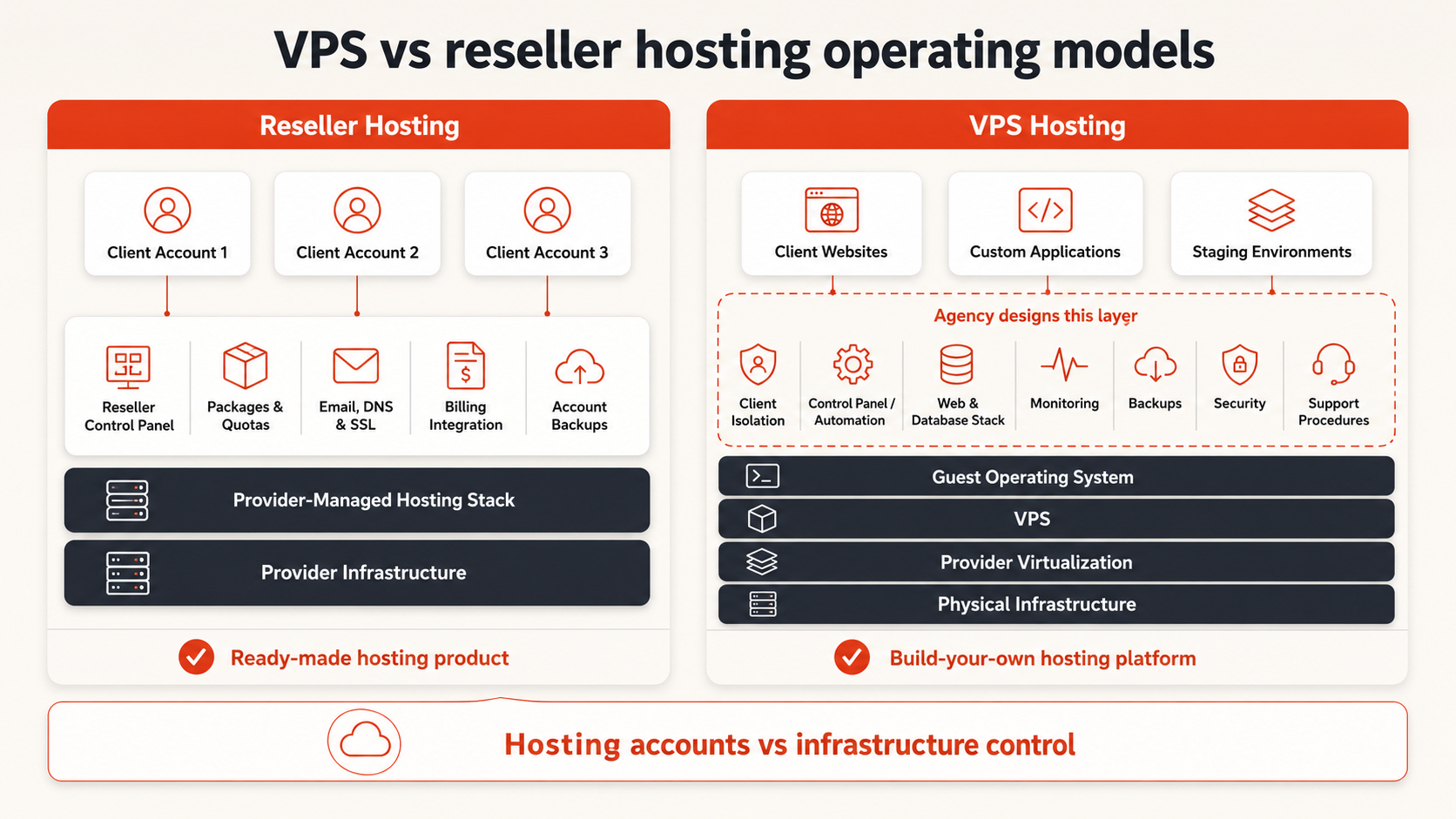
A VPS is a virtual server. The provider operates the physical infrastructure and virtualization platform, while the VPS customer controls the guest operating system and chooses how client websites are deployed and separated.
| Area | Reseller hosting | VPS hosting |
|---|---|---|
| Infrastructure ownership | Provider operates the hosting server | Agency controls its virtual server |
| Root access | Usually unavailable | Usually available |
| Client accounts | Built into the reseller platform | Agency must create the account model |
| Server software | Provider selects and maintains most of the stack | Agency selects or arranges the stack |
| Resource allocation | Limited by reseller plan and provider rules | Limited by VPS resources and agency design |
| Support path | Agency escalates platform issues to reseller provider | Agency handles the VM and escalates infrastructure issues to VPS provider |
| Custom software | Usually restricted | Usually flexible |
| Operational workload | Lower | Higher |
| Migration control | Depends heavily on provider tools | More control, but more migration planning |
| Scaling model | Upgrade reseller package or move provider | Resize, split workloads, or add VMs |
The key distinction is not simply shared hosting versus dedicated resources. It is whether the agency is reselling a provider-defined hosting product or building its own hosting platform on a virtual server.
What Reseller Hosting Gives an Agency
Reseller hosting is designed around account creation and packaging.
Depending on the provider, a reseller plan may include:
- A reseller control panel
- Separate client hosting accounts
- Storage and bandwidth quotas
- Website, database, email, and DNS tools
- White-label nameservers or branding options
- Billing integrations
- SSL workflows
- Backup features
- Provider-managed server updates
- A support escalation path
In cPanel & WHM environments, resellers can create and manage the cPanel accounts they own, while the server administrator defines their privileges and account limits. Packages can be used to set restrictions such as disk space and bandwidth.
This model is useful because the agency can sell hosting without first designing user isolation, quota enforcement, account suspension, or customer-facing control-panel access.
The trade-off is that the provider controls the server, software versions, allowed features, resource policies, and many technical decisions.
What a VPS Gives an Agency
A VPS gives the agency a server rather than a ready-made reseller product.
The agency can choose:
- Operating system
- Web server and runtime
- Control panel or no control panel
- Account-isolation method
- Database architecture
- Backup design
- Monitoring stack
- Security tooling
- Deployment workflow
- Email strategy
- DNS provider
- Resource allocation
- Automation and APIs
This flexibility supports traditional hosting, custom application hosting, containerized sites, staging environments, client-specific software, and more advanced agency workflows.
But a VPS does not automatically include a client hosting system. The agency must build or purchase the layers that reseller hosting bundles together.
That may include:
- A commercial control panel
- Per-client Linux users or containers
- Resource limits
- Billing and provisioning automation
- Monitoring and alerting
- Backup and restore processes
- Malware response
- Customer access controls
- Documentation and support procedures
A VPS can improve control and margins, but only when the agency can operate the resulting platform reliably.
This Decision Is Separate From cPanel and Managed Hosting
Three related decisions are often mixed together:
| Decision | Question |
|---|---|
| VPS vs reseller hosting | Should the agency resell provider-managed hosting or operate its own server platform? |
| VPS with or without cPanel | Should the server use cPanel as its hosting-management interface? |
| Managed vs unmanaged VPS | Who maintains the guest operating system and services? |
An agency can run cPanel on a VPS and create reseller-style client accounts. It can also build a VPS platform without cPanel.
Similarly, a VPS may be self-managed, managed by the provider, or operated by an MSP. Reseller hosting is normally provider-managed at the server layer, but the agency still owns customer communication, website-level support, and many service-delivery tasks.
For the panel decision, read VPS Hosting With or Without cPanel. For the responsibility boundary, read Managed vs Unmanaged VPS.
Client Account Separation Is the First Major Difference
Reseller hosting usually starts with an account model. Each client can receive a separate hosting account with its own files, databases, email, domains, usage limits, and login.
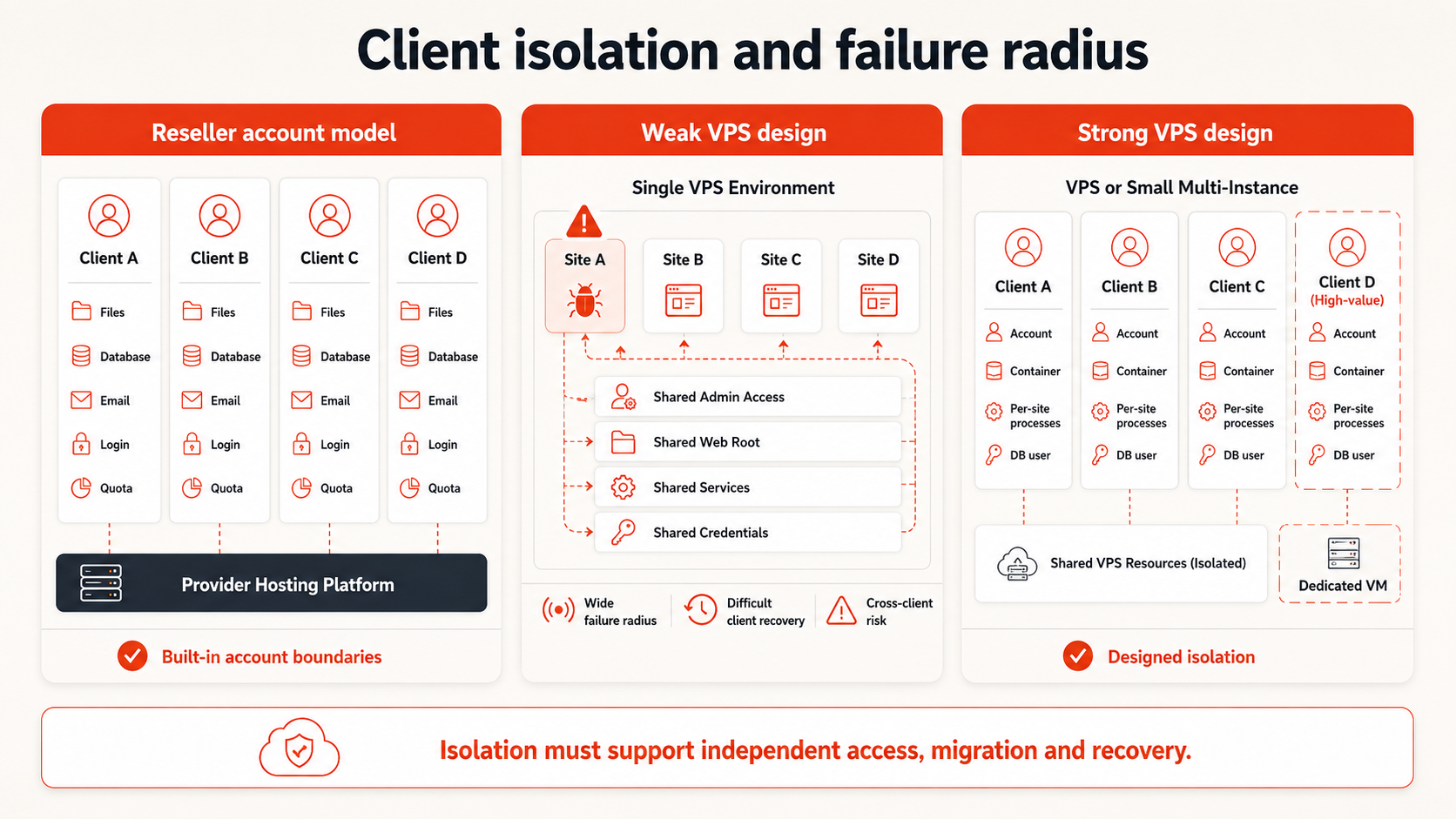
That separation helps with:
- Client onboarding
- Access control
- Account suspension
- Migration
- Resource packages
- Billing alignment
- Customer handoff
- Reducing accidental cross-client access
A VPS can provide equal or stronger separation, but it must be designed.
Common VPS separation models include:
- Separate control-panel accounts
- Separate Linux users
- Containers
- Separate application processes
- Per-site PHP pools
- Dedicated databases or database users
- Separate VMs for high-value clients
Simply placing every website under one administrator account is not a strong multi-client architecture. One compromised site, incorrect permission, or failed deployment can affect the entire portfolio.
For agencies, the question is not only whether multiple websites fit on the server. It is whether clients can be isolated, supported, migrated, and recovered independently.
Control and Custom Software Favor VPS Hosting
Reseller plans are designed for standard hosting workloads. They often work well for WordPress, PHP, static sites, databases, email accounts, and common CMS platforms.
They become restrictive when the agency needs:
- Custom server packages
- Node.js, Python, Go, or Java services outside supported workflows
- Docker or container orchestration
- Background workers
- Custom reverse-proxy rules
- Private services
- Specialized caching
- Non-standard database engines
- Custom monitoring agents
- CI/CD-controlled deployments
- Application-level networking
A VPS is usually the better fit when the agency is hosting applications rather than only websites.
Reseller hosting is usually the better fit when customers need a conventional hosting account and the agency does not benefit from server-level customization.
Resource Control Works Differently
With reseller hosting, the agency receives capacity inside a provider-controlled server. The provider decides how the underlying machine is operated and how accounts share resources.
The reseller may be able to define packages and quotas, but may not have full visibility into host-level CPU contention, storage architecture, service configuration, or the activity of unrelated resellers.
With a VPS, the agency receives a defined allocation of virtual CPU, RAM, storage, and networking. The agency controls how those resources are distributed among its clients.
This creates more control but also more responsibility.
The agency must decide:
- How many sites belong on one VPS
- Whether one client can consume excessive CPU or memory
- When a site should move to a separate VM
- How storage growth is monitored
- How backups affect disk and I/O
- How traffic spikes are handled
- Which customers require stronger isolation
A VPS does not provide unlimited capacity. It provides a clearer resource boundary that the agency must actively manage.
Support Escalation Can Determine the Better Model
Reseller hosting gives the agency a layered support model:
- The client contacts the agency.
- The agency investigates the website or account.
- The agency escalates server-level issues to the reseller provider.
This can reduce infrastructure work, but it also creates dependency. The agency may not have enough access to diagnose a slow server, mail issue, blocked service, or configuration limit directly.
With VPS hosting, the agency has more diagnostic control. It can inspect logs, services, resource usage, network configuration, and application behavior.
However, the VPS provider normally supports the infrastructure and platform—not every website, plugin, database query, or custom application running inside the VM.
Before choosing either model, define who handles:
- Website errors
- CMS and plugin failures
- Email delivery
- DNS mistakes
- SSL issues
- Malware cleanup
- Operating-system updates
- Service outages
- Backup restoration
- Resource exhaustion
- After-hours incidents
The best model is the one where the agency can resolve or escalate customer-impacting problems within its promised service level.
Compare Total Cost and Agency Margin
Reseller hosting usually has a simple commercial model. The agency pays one package fee and sells smaller plans to clients.
A VPS may have a lower infrastructure cost per site at scale, but the server is only one part of the cost.
Reseller hosting total cost
= reseller plan
+ optional add-ons
+ agency support time
+ migration and provider dependency risk

VPS hosting total cost
= VPS
+ control panel or automation
+ backups and storage
+ monitoring and security tools
+ server administration
+ incident response
+ agency support time
Agencies should measure margin after labor, not only after hosting invoices.
A VPS that saves $30 per month but creates several hours of maintenance is not necessarily more profitable. A reseller plan with a higher per-site cost may still be better when it allows the agency to focus on design, development, SEO, or retainers.
A VPS becomes financially attractive when:
- The agency has enough recurring clients
- Server operations are standardized
- Provisioning and backups are automated
- Support processes are documented
- The team already has infrastructure skills
- The agency needs features reseller plans cannot provide
- The cost of provider restrictions exceeds the cost of operating the VPS
White Labeling and Client Experience
Reseller hosting is often built for white-label service delivery. Providers may allow custom nameservers, branded control panels, customer packages, and billing integrations.
A VPS offers more branding freedom because the agency controls the platform, but building a polished client experience requires additional work.
The agency may need to provide:
- Client login portal
- Hosting dashboard
- Usage reporting
- Password-reset workflow
- Billing integration
- Suspension and cancellation automation
- Documentation
- Support ticketing
- Status communication
Some agencies do not need customer-facing hosting controls. They manage every site internally and bundle hosting into a maintenance retainer. In that model, a VPS may work without a reseller-style interface.
Other agencies want clients to manage domains, email accounts, files, or databases directly. Reseller hosting may provide that experience faster.
Security and Risk Concentration
Both models can concentrate many clients on shared infrastructure.
With reseller hosting, the provider owns the server-security architecture, while the agency manages client websites, credentials, and account access.
With VPS hosting, the agency or its management partner also owns the guest operating system, service configuration, and client-isolation design.
Important risks include:
- One compromised site affecting other clients
- Shared administrator credentials
- Inadequate account separation
- Backups stored only on the hosting server
- One server outage affecting the entire client portfolio
- A traffic spike exhausting shared resources
- Malware spreading through writable directories
- An agency administrator making a server-wide mistake
A VPS allows stronger customization, but it does not automatically create stronger security. The agency must implement the controls that a reseller provider would otherwise manage.
High-value or high-risk clients may need separate VMs even when smaller customers remain consolidated.
Backup and Migration Control
Reseller hosting often provides account-level backups and migration tools. These can make it easier to move individual websites between compatible hosting environments.
But the agency should verify:
- Whether backups are included
- Whether restores are self-service
- Whether backups are stored outside the server
- How long data is retained
- Whether email and DNS settings are included
- Whether the provider charges for migrations
- How easily accounts can move to another platform
A VPS gives the agency more freedom to design backups around business requirements. It can combine provider snapshots, file backups, database dumps, and off-server storage.
The trade-off is that the agency must test and document recovery.
Migration from reseller hosting to VPS is easier when each client already has a clean account boundary. Migration becomes harder when domains, email, databases, and websites are tightly coupled to provider-specific systems.
When Reseller Hosting Is the Better Choice
Reseller hosting is usually the better default when:
- The agency is launching its first hosting service
- Most clients run conventional websites or WordPress
- The team does not have a server administrator
- Fast client-account provisioning matters
- Customers need a familiar hosting interface
- The agency wants the provider to maintain the server stack
- Predictable support escalation is more important than root access
- The number of hosted clients is still modest
- Custom software is rarely required
- The agency wants to minimize infrastructure risk
This model lets the agency validate demand before investing in its own hosting platform.
When VPS Hosting Is the Better Choice
A VPS is usually the better default when:
- Root access is required
- The agency hosts custom applications
- Clients need different runtimes or services
- The team can operate Linux securely
- The reseller provider creates performance or configuration limits
- The agency wants deeper monitoring and automation
- Client volume makes per-account reseller pricing inefficient
- The agency needs predictable control over resources
- Some customers need private services or advanced networking
- The agency wants to split workloads across multiple servers over time
The agency does not need to operate everything internally. A managed service, MSP, or dedicated infrastructure partner can manage the VPS while the agency retains architectural control.
Decision Framework for Agencies
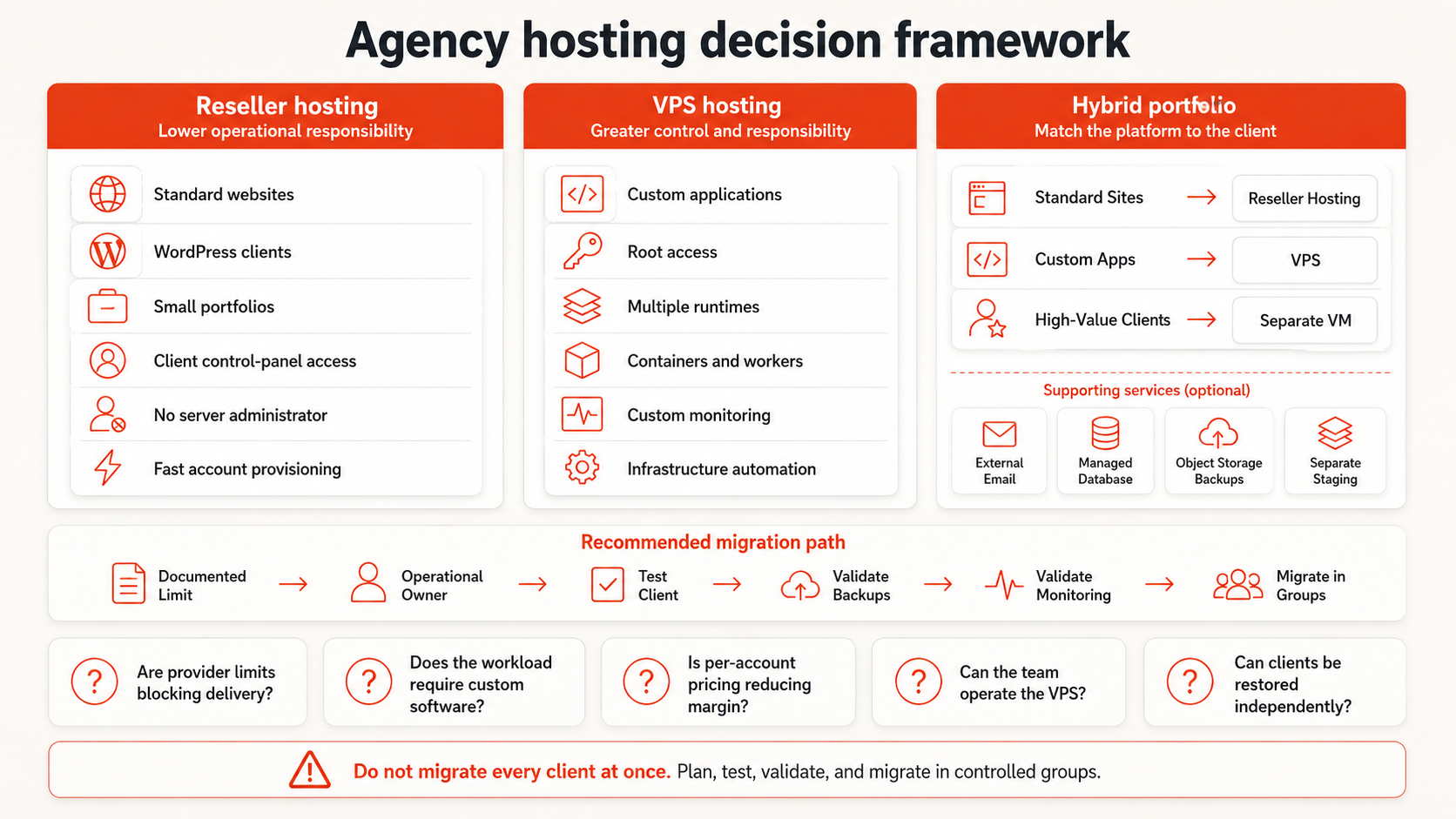
| Agency situation | Better starting point | Reason |
|---|---|---|
| Freelancer hosting five brochure sites | Reseller hosting | Low operational burden |
| WordPress agency with standard client sites | Reseller hosting may fit | Account workflows are already packaged |
| Development agency hosting custom Node.js apps | VPS | Custom runtime and server control |
| Agency with no Linux administrator | Reseller hosting | Lower infrastructure responsibility |
| Agency with DevOps capability | VPS | Automation and control can improve efficiency |
| Clients need individual control-panel access | Reseller hosting may fit | Faster customer account delivery |
| Hosting is bundled into a managed retainer | VPS may fit | Clients may not need direct platform access |
| One client needs custom software | Separate VPS | Avoid forcing the whole portfolio into one model |
| Agency is constrained by provider limits | VPS | More control over software and resources |
| Agency wants to become a hosting provider | VPS or multi-server platform | Greater control, but higher operational commitment |
Use these questions:
- Does the agency want to sell hosting accounts or operate infrastructure?
- Do clients need direct access to hosting tools?
- Does the workload require root access or custom software?
- Who handles server updates, monitoring, backups, and incidents?
- Can client accounts be isolated and restored independently?
- What is the real margin after administration and support time?
- What happens when the current provider becomes restrictive?
- How many clients can one failure affect?
- Can the agency meet its support promises with the available access?
- Is the current model still suitable after the next 10 clients?
When to Move From Reseller Hosting to a VPS
Moving to a VPS should solve a documented constraint, not simply make the hosting stack feel more professional.
Common migration signals include:
- The agency repeatedly hits account, storage, bandwidth, or software limits
- Clients need runtimes the reseller platform does not support
- Performance troubleshooting requires server-level visibility
- Per-account pricing is reducing margin
- The agency needs custom backups or monitoring
- Provider support delays are affecting client service
- The agency wants to automate provisioning and deployment
- Important clients need stronger isolation
- The agency has someone who can own server operations
- A staged migration plan has been tested
Do not migrate every client at once by default. A safer path is to move one low-risk account, validate provisioning, backups, monitoring, and support procedures, and then migrate in controlled groups.
A Hybrid Model Is Often the Practical Answer
Agencies do not need to place every client on the same platform.
A hybrid portfolio can use:
- Reseller hosting for small, standard websites
- VPS instances for custom applications
- Dedicated VMs for high-value customers
- External email for all clients
- Managed databases for application workloads
- Object storage for backups and media
- Separate staging environments for development clients
This reduces the pressure to make one hosting model serve every customer.
The agency can keep low-complexity accounts on reseller hosting while moving clients to VPS only when control, performance, or software requirements justify the added responsibility.