
A KVM VPS is a full virtual machine with its own guest kernel and virtual hardware, while an OpenVZ container is an operating-system-level environment that shares the host kernel. KVM usually provides broader operating-system compatibility and a stronger VM-style boundary; OpenVZ containers usually provide lower virtualization overhead and higher host density.
The comparison needs one important clarification. Modern OpenVZ platforms can manage both containers and KVM-based virtual machines. In this guide, OpenVZ means the container-based VPS model that hosting providers commonly contrast with a KVM VPS—not every capability of the OpenVZ platform.
Neither label guarantees faster hosting. Performance depends on CPU allocation, memory policy, storage latency, network capacity, oversubscription, and provider operations. A well-managed OpenVZ container can outperform a poorly managed KVM VPS, while a properly sized KVM VPS can provide capabilities an OS-level container cannot.
For the virtualization layer first, read what a hypervisor is. For the wider server architecture, see how VPS hosting works.
KVM and OpenVZ Containers Virtualize Different Layers
KVM and OpenVZ containers can both present customers with an isolated server-like environment, but they create that environment at different layers.
KVM uses hardware-assisted virtualization. The provider creates a virtual machine with virtual CPU, memory, storage devices, networking, firmware, and a guest operating system. The guest boots its own kernel and behaves like an independent computer.
An OpenVZ container uses operating-system-level virtualization. The container has its own files, processes, users, resource limits, and network identity, but it runs on the host’s Linux kernel rather than booting a separate guest kernel.
A simplified comparison looks like this:
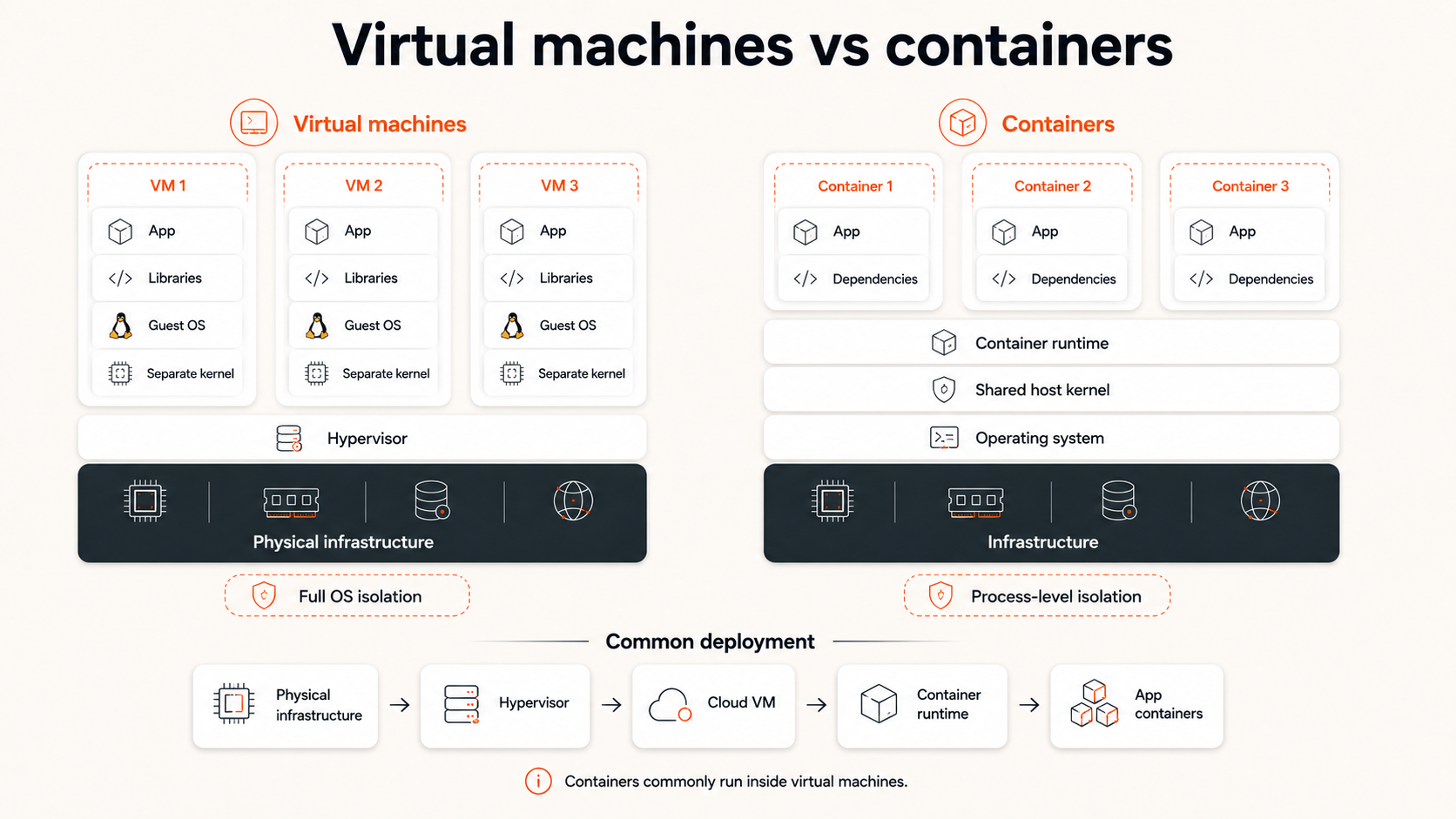
This architectural difference affects kernel control, supported operating systems, device access, isolation boundaries, maintenance behavior, and virtualization overhead.
It does not automatically determine the quality of the VPS plan. The provider still decides how resources are allocated and how aggressively the host is shared.
A KVM VPS Runs as a Full Virtual Machine
KVM stands for Kernel-based Virtual Machine. It provides the Linux host with the interfaces needed to create and operate virtual machines.
A KVM VPS normally receives:
- Virtual CPUs
- A defined memory allocation
- One or more virtual disks
- Virtual network interfaces
- Virtual firmware and boot configuration
- An independently booted guest operating system
- Its own guest kernel
The guest operating system sees a virtual computer. It can load its own kernel modules when supported, manage its own boot process, use its own filesystem, and run software that expects a conventional virtual machine.
This makes KVM a strong fit when the workload requires:
- Linux or Windows guest operating systems
- A custom or provider-supported alternative kernel
- Kernel-level features inside the guest
- Stronger separation between guest environments
- Full operating-system installation and boot behavior
- Software that expects standard virtual hardware
- More control over low-level networking or storage configuration
A KVM VPS remains virtualized. The physical CPU, storage platform, network links, and host hardware can still be shared with other VMs unless the provider explicitly offers dedicated hardware.
KVM also does not mean every vCPU is dedicated. Providers can offer shared, burstable, reserved, or dedicated CPU plans on KVM infrastructure. The CPU policy must be evaluated separately from the virtualization technology.
An OpenVZ Container Shares the Host Kernel
An OpenVZ container is an isolated Linux environment created at the operating-system layer.
Each container can have its own:
- Filesystem and installed packages
- Processes and process identifiers
- Users and permissions
- Hostname and network configuration
- Resource limits
- Startup configuration
- Application stack
The container feels server-like to the user, but it does not boot an independent kernel. Its processes use the host Linux kernel under container-level isolation and resource controls.
This lighter model can reduce virtualization overhead because the provider does not need to run a complete guest kernel for every container. It can also support higher instance density on the physical host.
OpenVZ containers can be a practical fit for:
- Standard Linux web hosting
- Lightweight development environments
- Small application servers
- Automation tools
- Test workloads
- Linux services that do not require custom kernels
- Cost-sensitive workloads with conventional software requirements
The shared-kernel model creates limits. The container cannot run Windows as its guest operating system. It cannot independently boot a different kernel family, and some low-level kernel features may be unavailable or controlled by the provider.
The exact capabilities depend on the OpenVZ release, host configuration, container privileges, and provider policy. Buyers should not assume that every OpenVZ service exposes the same kernel features or device access.
Kernel Control Changes OS and Software Compatibility
Kernel control is the clearest practical difference between a KVM VPS and an OpenVZ container.
A KVM VM boots its own guest kernel. The provider still controls the physical host and virtualization layer, but the customer can manage the guest operating system as a complete VM.
An OpenVZ container shares the host kernel. The customer controls the container’s userspace, packages, files, and applications but does not independently replace or boot the underlying kernel.
| Requirement | KVM VPS | OpenVZ container |
|---|---|---|
| Independent guest kernel | Yes | No |
| Linux guest | Yes | Yes, within supported container templates and host compatibility |
| Windows guest | Possible when offered by the provider | No |
| Custom kernel | Possible within provider and guest constraints | Not independently booted |
| Kernel modules | Guest and provider dependent | Primarily controlled at the host level |
| Standard VM boot process | Yes | No full guest-kernel boot |
| Low-level device features | Possible when exposed by provider | More restricted |
| Conventional Linux applications | Strong fit | Strong fit when kernel requirements are standard |
This difference matters most when software depends on a particular kernel version, custom kernel module, nested virtualization, low-level network feature, security module, or operating system outside the supported Linux container model.
For ordinary websites, APIs, reverse proxies, automation tools, and small Linux services, the workload may not need independent kernel control. In that case, the decision should move to resource guarantees, reliability, backup options, and support rather than kernel architecture alone.
Isolation and Resource Guarantees Are Separate Questions
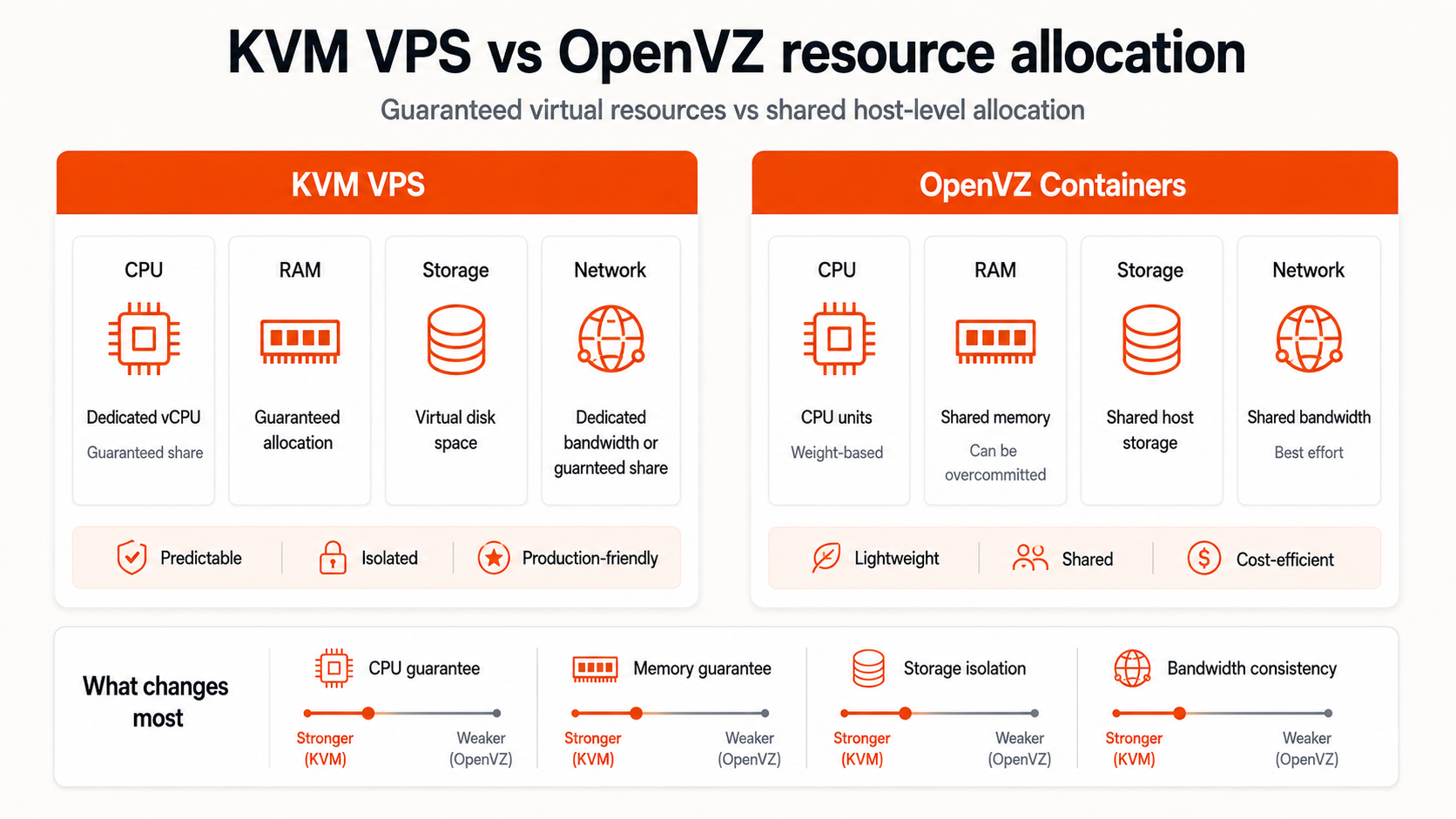 KVM and OpenVZ both isolate customer environments, but they do not use the same boundary.
A KVM VPS separates complete guest operating systems through a virtual machine boundary. Each VM has its own kernel, virtual memory space, virtual devices, filesystem, processes, and operating-system configuration.
An OpenVZ container separates Linux userspace environments while sharing the host kernel. Filesystems, processes, users, and resource controls remain isolated at the container layer, but the kernel is common infrastructure.
This usually gives KVM a stronger and more general-purpose isolation model. However, the virtualization type is only one part of security.
The complete risk model also includes:
- Host patching
- Hypervisor or container-runtime maintenance
- Provider access controls
- Capacity management
- Guest operating-system patching
- Firewall configuration
- Account and key security
- Backup and restore design
- Monitoring and incident response
Resource guarantees are also separate from isolation.
A KVM VPS can still use shared CPU, shared storage, and shared networking. An OpenVZ container can have strict CPU and memory limits. The terms KVM and OpenVZ do not reveal how much contention a provider permits.
Buyers should verify:
- Whether CPU is shared, burstable, reserved, or dedicated
- Whether the advertised RAM is guaranteed
- Whether swap or memory pressure is handled inside or outside the guest
- Which storage limits apply
- Whether network transfer is capped or governed by fair use
- Whether sustained CPU use is allowed
- How the provider responds to noisy-neighbor conditions
For the resource terminology behind many provider labels, read VPS vs VDS. For compute allocation specifically, see shared vs dedicated vCPU.
Performance Depends on Workload and Provider Capacity
OpenVZ containers are lighter because they share the host kernel and do not emulate a complete virtual hardware environment for every instance. This can reduce memory consumption and virtualization overhead.
KVM introduces a fuller virtual machine layer, but modern hardware-assisted virtualization can still provide strong performance. The VM model also gives the provider and customer clearer guest boundaries and broader operating-system flexibility.
The correct conclusion is not that one technology is always faster.
Real VPS performance depends on:
- Physical processor generation and clock behavior
- CPU scheduling and oversubscription
- Shared or dedicated CPU policy
- Memory allocation and host pressure
- Storage latency, throughput, and IOPS
- Network capacity and routing
- Host density
- Workload shape
- Provider monitoring and capacity planning
A lightweight OpenVZ container can perform well for a standard Linux service when the host is managed conservatively. A KVM VPS can perform well for sustained applications when CPU, memory, storage, and networking are allocated appropriately.
Both can perform badly when too many workloads compete for the same host resources.
Workload shape matters more than synthetic labels
A small web server that spends most of its time idle may not benefit from the fuller KVM boundary if it has no kernel-specific requirements.
A database, build worker, security appliance, custom networking workload, or Windows application may need the control and compatibility of a full VM.
A benchmark should also be interpreted carefully. Short CPU tests can reward burst capacity. Storage benchmarks can change depending on cache state and neighboring activity. Network tests may reflect routing and location more than virtualization overhead.
The better question is:
Does this service provide the control, consistency, compatibility, and recovery model required by the workload?
Use a Decision Framework Instead of Picking by Label
Choose based on technical requirements first, then compare provider implementation.
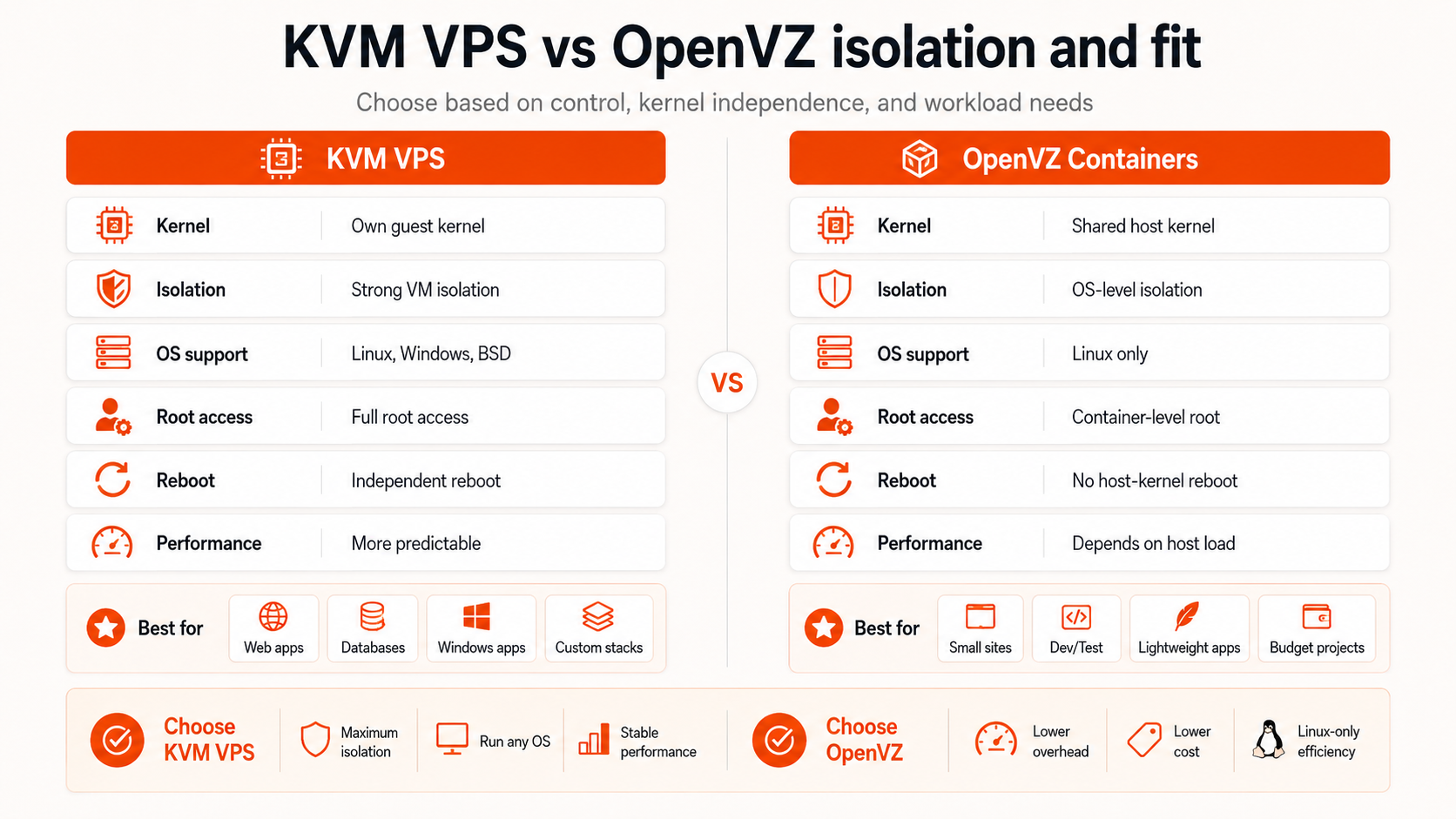
| Workload requirement | Better starting point | Why |
|---|---|---|
| Windows operating system | KVM VPS | Requires a separate guest operating system and kernel |
| Custom guest kernel | KVM VPS | Full VM can boot its own supported kernel |
| Standard Linux website | Either | Resource quality and provider operations matter more |
| Lightweight Linux service | OpenVZ can fit | Lower-overhead container model may be sufficient |
| Docker host | Usually KVM VPS | Full VM boundary and kernel control reduce compatibility uncertainty |
| Kernel modules or low-level networking | KVM VPS | More guest-level control when provider permits it |
| Simple development sandbox | Either | Choose based on price, recovery, and required features |
| Stronger VM-style isolation | KVM VPS | Independent guest kernel and virtual hardware boundary |
| Maximum density for standard Linux workloads | OpenVZ container | Shared-kernel model reduces per-instance overhead |
| Sustained CPU workload | Plan with documented CPU guarantees | Virtualization label alone is insufficient |
| Nested virtualization | KVM, only when explicitly supported | Requires host and provider support |
| Lowest-cost Linux environment | Compare both | Provider pricing and resource policy decide value |
Use this sequence:
- Check operating-system requirements. Windows or a nonstandard guest environment points toward a full VM.
- Identify kernel dependencies. Custom modules, kernel versions, nested virtualization, or low-level networking usually favor KVM.
- Measure workload behavior. Determine whether CPU, memory, storage, or network consistency is the real constraint.
- Read the provider’s resource policy. Shared versus dedicated CPU and sustained-use rules matter more than the brand name.
- Compare recovery and support. Snapshots, backups, console access, rebuild options, and support scope affect operational risk.
- Avoid paying for control you do not need. A conventional Linux workload can run well without custom kernel access when the service is managed properly.
Ask the Provider These Questions Before Buying
A provider that advertises KVM VPS or OpenVZ VPS should explain what the label means in its own platform.
Virtualization and operating system
- Is the service a full VM or an OS-level container?
- Does the instance boot its own guest kernel?
- Which Linux distributions are supported?
- Is Windows supported?
- Can the kernel be changed?
- Are custom kernel modules allowed?
- Is nested virtualization available?
Compute and memory
- Is CPU shared or dedicated?
- Is sustained CPU usage permitted?
- What does one vCPU represent?
- Is the advertised RAM guaranteed?
- Are memory or process limits applied outside the guest?
Storage and networking
- What storage technology is used?
- Are throughput or IOPS limits published?
- Can storage expand independently?
- What bandwidth and transfer policy applies?
- Are private networking and IPv6 available?
Recovery and operations
- Are snapshots and automated backups available?
- Can the instance be rebuilt from an image?
- Is browser console access provided?
- Who handles host-level security updates?
- What support and uptime commitments apply?
A transparent provider should answer these questions without relying on “KVM” or “OpenVZ” as a substitute for service details.